






What is Replit AI?
What is Replit AI is the question many executives ask when evaluating tools that promise to turn ideas into deployed software with minimal friction. Replit AI is the AI‑powered coding agent embedded in the Replit app, a cloud development environment designed to generate, edit, test and deploy multi‑file applications from natural language prompts and incremental instructions. It sits in the category of cloud development environments (CDEs) with an integrated AI agent, positioned between simple code autocompletion tools and full platform engineering suites. The product targets rapid prototyping, team collaboration and production hosting, combining AI code synthesis with one‑click deployment and built‑in integrations. Replit began as an online IDE that removed local setup barriers by offering instant environments in the browser. Over successive releases it added an AI agent capable of multi‑step app generation, automated dependency installation, database and auth scaffolding, and CI/CD patterns, all executed within the browser‑hosted Replit app workspace. For business leaders the strategic value is straightforward: compress the time from concept to live product, reduce dependence on local developer environments, and provide non‑technical stakeholders a pathway to create and iterate MVPs. The most compelling use contexts are early product discovery, distributed team collaboration, and marketing or operations initiatives that require fast, testable software outcomes.Key insights
- Replit AI combines an AI agent with the Replit app to generate multi‑file, production‑oriented applications from natural language and iterative prompts.
- The platform supports 50+ programming languages and integrates with common services (Stripe, Google Workspace, external APIs) to accelerate end‑to‑end app delivery.
- Replit Agent v2 can perform multi‑step tasks—installing libraries, creating database schemas, adding authentication and configuring autoscale deployments—without manual environment setup.
- Enterprise capabilities include SOC 2 Type II compliance, SSO/SAML and SCIM, making the platform viable for regulated teams and larger engineering organisations.
- Typical business outcomes are faster MVP delivery, reduced onboarding friction for new engineers, and improved cross‑functional collaboration through browser‑based workspaces.
Business Problems It Solves
Replit AI addresses friction in the software delivery lifecycle that impacts product velocity, developer onboarding and non‑technical experimentation.- Long setup times and environment inconsistencies that delay feature work and increase developer context switching.
- High cost of prototyping due to dependence on senior engineers for routine scaffolding (auth, database, CI/CD).
- Silos between product, marketing and engineering that slow validation of customer‑facing experiments.
- Operational complexity in deploying and scaling simple web services for campaigns or pilot projects.
Core Features
The following features convert technical capabilities into explicit business outcomes for CEOs, Founders and CMOs.AI Agent (Replit Agent v2)
Business Value: Enables non‑linear, multi‑step creation of applications from plain English instructions. This reduces reliance on senior developers for routine scaffolding, shortens MVP cycles and allows product teams to validate hypotheses rapidly.Instant, Cloud‑Hosted Environments
Business Value: Eliminates local machine setup and environment drift, reducing onboarding time for new engineers and contractors. Teams can scale experiments geographically without IT provisioning.One‑Click Deployment and Autoscaling
Business Value: Converts prototypes into hosted services with minimal operations overhead, enabling marketing campaigns or pilot programmes to launch quickly and handle variable traffic without manual ops intervention.Built‑In Integrations and Secrets Management
Business Value: Accelerates integration with payment providers, databases and third‑party APIs, reducing integration engineering time and secure credential handling risks during prototyping and early production.Collaborative Editing and Real‑Time Sharing
Business Value: Facilitates synchronous and asynchronous collaboration between engineers, product managers and marketers, enabling faster decision cycles and shared ownership of deliverables.Automated Testing, CI/CD and Rollback
Business Value: Instills engineering best practices into early builds, lowering production risk and shortening mean time to recovery (MTTR) when issues appear in pilot deployments.Security and Enterprise Controls
Business Value: Provides governance features (SSO/SAML, SOC 2 controls, role‑based access) that allow the platform to be adopted by regulated teams without compromising security or compliance requirements.Main Strategic Use Cases
Replit AI is useful where speed to experiment or deploy outweighs custom local tooling; it complements rather than replaces mature engineering toolchains.Product Discovery and MVPs
When to use: For early hypothesis testing where rapid iteration and low cost per experiment are priorities. Product teams can ask the agent to scaffold a feature set and iterate with customers in days rather than weeks.Internal Tools and Automations
If you operate in an organisation with recurring manual tasks, Replit AI can rapidly generate internal web tools, dashboards or automation scripts that remove bottlenecks in sales, support or operations.Marketing‑Led Campaigns
For businesses that need quick landing pages, simple API‑driven microsites or demo apps for events, Replit AI shortens delivery time and allows marketing owners to own iterations without full dev cycles.Business Operations Use Cases
Operational teams use Replit AI to build and maintain lightweight applications and integrations that solve day‑to‑day problems without large engineering investments.- Automated data ingestion pipelines and visual dashboards for operations metrics.
- Self‑service admin panels for non‑engineering staff, built and iterated quickly.
- Temporary services for integrations during strategic partnerships or pilots.
Marketing Use Cases
Marketing teams leverage Replit AI to prototype customer experiences and measure conversion without blocking on engineering roadmaps.- Campaign microsites with embedded payment flows and A/B test variants.
- Interactive demos and product sandboxes for sales enablement and events.
- Rapid personalisation experiments that integrate with CRM or analytics tools.
How It Works (Executive clarity)
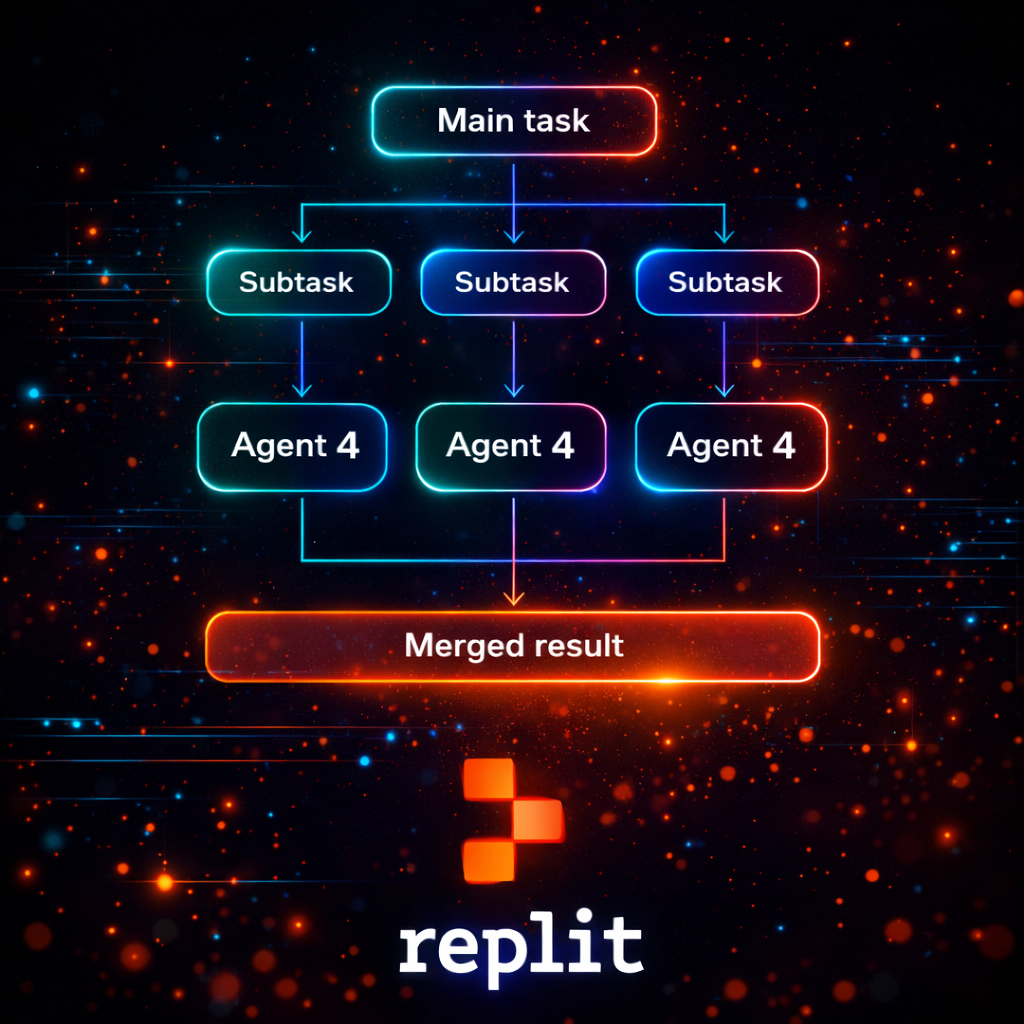
Replit AI operates as an integrated agent inside the Replit app that transforms natural language into code, executes it in ephemeral or persistent cloud containers, and offers deployment options to scale.- Prompt & Scope: A user describes an app, feature or task in natural language and the agent clarifies intent through follow‑ups if needed.
- Scaffold & Integrate: The agent generates multi‑file code, installs dependencies and configures integrations such as databases or payment services.
- Test & Iterate: Built‑in runtime allows immediate execution and debugging in the browser; the agent can fix errors and refine features iteratively.
- Deploy & Scale: With one click the app is deployed to Replit hosting with autoscaling, CI/CD hooks and rollback capabilities for production readiness.
Ready to improve your marketing with AI?
Alternatives and Competitor Tools
Several tools overlap with Replit AI in code assistance, app generation and cloud hosting; the choice depends on the required depth of automation, integration breadth and hosting model.GitHub Copilot
GitHub Copilot is an AI code completion and suggestion tool embedded in IDEs. It excels at inline developer productivity but does not provide browser‑hosted environments or one‑click deployment; it is suited to teams that prefer local development and want AI assistance during coding rather than end‑to‑end app generation.Trickle AI
Trickle AI focuses on AI‑assisted documentation and knowledge workflows and includes some developer-centric features for app composition. It is stronger for knowledge management scenarios but does not match Replit for hosted runtime, multi‑file automated scaffolding or production deployment.Cloud IDEs with Extensions (e.g., Gitpod, Visual Studio Codespaces)
These platforms provide cloud development environments with varying levels of integration. They cater to organisations that want cloud workspaces but typically require separate CI/CD and deployment configuration, whereas Replit bundles these capabilities with an AI agent.Low‑code Platforms (e.g., Bubble, Retool)
Low‑code tools accelerate app delivery for non‑developers and are useful for building internal tools and dashboards. They trade flexibility for speed; Replit is more appropriate when custom code, language choice and direct API integrations are required alongside rapid iteration. Decision synthesis: choose Replit AI when you need rapid, code‑first prototypes that can graduate to production hosting with minimal ops friction. Choose Copilot or cloud IDEs when you prioritise local workflows or deeper IDE integration.Comparison Table
The table below compares Replit AI with GitHub Copilot across executive decision factors.| Decision Factor | Replit AI | GitHub Copilot |
|---|---|---|
| Primary capability | End‑to‑end app generation, hosted runtime and deployment from the browser | AI code completion and suggestions inside developer IDEs |
| Use case fit | MVPs, rapid prototyping, marketing microsites, internal tools | Developer productivity, feature implementation in existing codebases |
| Automation level | High — scaffolding, dependency installation, deployment automation | Moderate — line and block level suggestions requiring developer action |
| Integration ecosystem | Pre‑built integrations, secrets management and hosted services | Depends on local environment and developer‑configured integrations |
| Scalability & hosting | Built‑in hosting with autoscaling and CI/CD patterns | No hosting; pairs with existing deployment pipelines |
| Governance & compliance | Enterprise controls, SOC 2 Type II and SSO options | Governance depends on organisation’s toolchain and policies |
| Best for | Cross‑functional teams needing rapid live apps | Engineering teams focused on code quality and productivity |
Benefits & Risks
Adopting Replit AI delivers tangible benefits alongside operational considerations that leaders must weigh.- Benefits: Dramatically reduced time to prototype, lower onboarding burden, improved cross‑functional experimentation and predictable paths from prototype to hosted service.
- Risks: Potential for generated code quality gaps, hidden technical debt if prototypes bypass architecture reviews, and dependency on a single cloud provider for development and staging.
- Mitigations: Establish guardrails (code reviews, linters, security scans), reserve Replit for early stages with transition plans to standard pipelines for long‑term production systems.