Estimated reading time: 14 minutes
What is Model Context Protocol (MCP)?
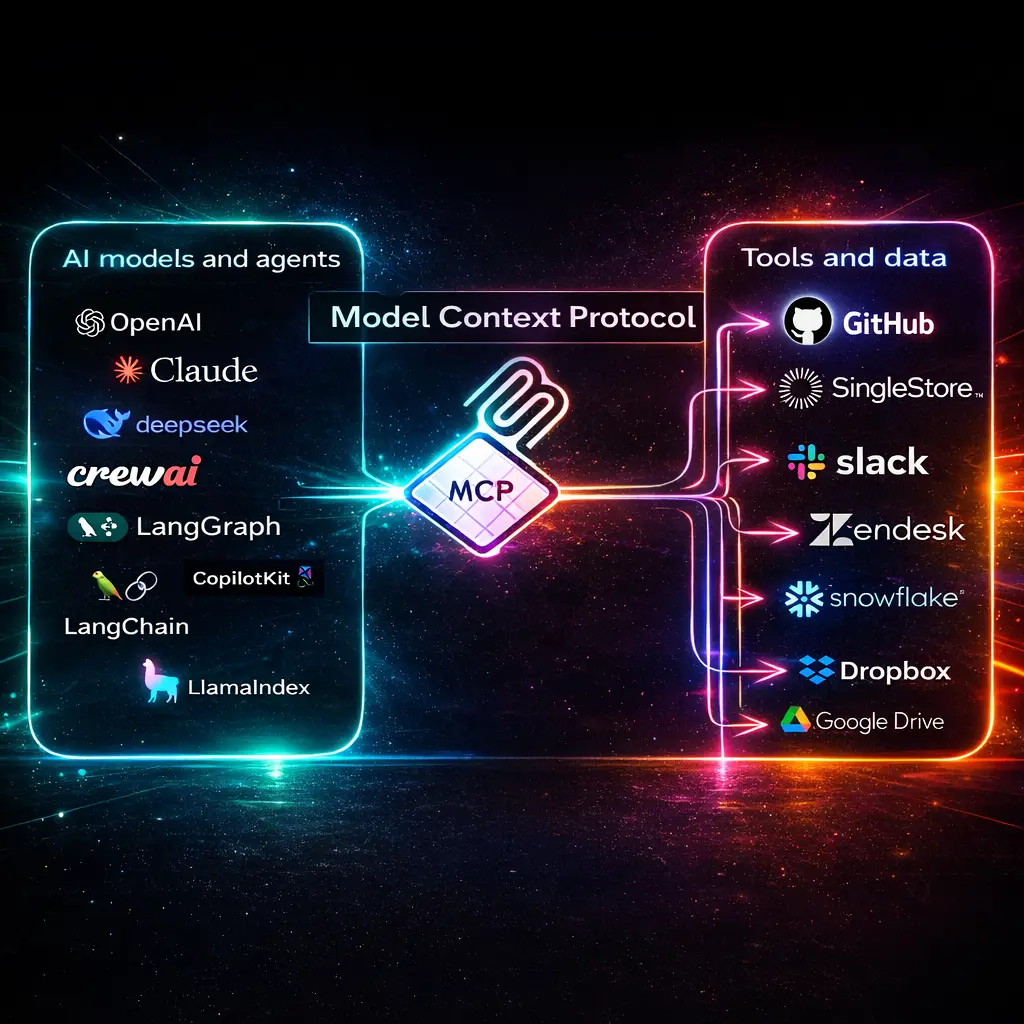
Model Context Protocol – MCP is a formal protocol that defines how an AI model receives, structures and maintains contextual information during processing. It standardises context representation so models interpret user data, session state and external signals consistently across calls and deployment environments.
MCP sits in the intersection of model orchestration and runtime management: it is not a model or a hosting platform but a control-layer technology that governs contextual inputs, metadata and state lifecycles for AI components. Executive teams should view it as a governance and integration artefact that improves predictability when models operate inside larger software systems.
Originally conceived to resolve inconsistent behaviour in conversational systems and multi-component AI pipelines, MCP emerged from the need to codify the assumptions models need to make about users, tasks and session continuity. Typical use environments include customer support bots, multi-turn agents, data-enriched prediction engines and multi-model orchestrations where state must be preserved reliably.
For business leaders, the core value of MCP is operational assurance: it reduces misinterpretation risk, accelerates time-to-value by making model behaviour repeatable across teams, and enables efficient scaling of model-driven features into production systems. When integrated correctly, it transforms ad-hoc context handling into an auditable, maintainable capability that supports product roadmaps and regulatory requirements.
Key insights
- MCP is a protocol for encoding, versioning and managing contextual state that models consume to make consistent inferences.
- It differs from APIs by focusing on the semantics and lifecycle of context rather than on request-response connectivity.
- MCP reduces model error rates in multi-turn and stateful scenarios by enforcing explicit context boundaries and constraints.
- Implementation introduces governance and engineering overhead and must be aligned with latency budgets and infrastructure capacity.
- When used with APIs and orchestration layers, MCP enables safer scaling of AI features across product lines and teams.
Business Problems It Solves
MCP addresses operational failures that arise when models lack a shared, machine-readable view of context across calls or services.
- Inconsistent conversational continuity: MCP prevents regressions where a model forgets prior user intents or contradicts earlier statements.
- Fragmented data interpretation: it standardises how entities, timestamps and user signals are presented to models, reducing misclassification.
- Compliance and auditability gaps: MCP creates an explicit trail of context changes that supports investigations and regulatory reporting.
- Integration ambiguity: it simplifies multi-vendor deployments by exposing a consistent contract for context, reducing costly bespoke adapters.
For product leaders deciding priorities: when to use MCP is often driven by whether your product requires session persistence, multi-turn reasoning or cross-service context sharing; if it does, MCP becomes a foundational piece rather than an optional optimisation.
Model Context Protocol (MCP) Features
MCP is implemented as a set of capabilities that translate into operational outcomes for businesses.
Context Schema and Typing
Business Value: A rigid schema enforces consistent data shapes and semantics so models receive predictable inputs. This lowers error rates in production, reduces debugging time for data teams and accelerates the onboarding of new models by removing ambiguity about expected inputs.
Versioning and Change Control
Business Value: Built-in versioning allows teams to evolve context models safely and roll back changes, which is essential for maintaining product stability during model updates and enabling controlled A/B experiments across customer segments.
State Lifecycle Management
Business Value: Explicit lifecycle rules (create, update, expire) reduce data drift and privacy exposure by enforcing retention policies and automated purging. This supports compliance and keeps state size deterministic for cost forecasting.
Context Constraints and Guardrails
Business Value: Declarative constraints prevent models from receiving contradictory or out-of-scope context, thereby improving reliability in decision-making and reducing the need for manual supervision in high-volume transactions.
Context Translation and Mapping
Business Value: Translation layers map internal data to canonical context forms so different teams and services can share a single context model. This enables reuse of the same model assets across products and simplifies cross-functional integration work.
Observability and Auditing
Business Value: Audit trails and telemetry tied to context changes make it possible to trace model outputs back to the exact contextual inputs, improving incident response, compliance reporting and senior stakeholder assurance.
Integration Hooks and Adapters
Business Value: Standardised adapters reduce integration costs with downstream systems and third-party APIs, enabling faster product experiments and lowering the engineering burden when evolving data sources.
Main Strategic Use Cases
MCP is strategically relevant for any business deploying stateful or multi-component AI where consistency and continuity affect user experience or risk.
- Conversational platforms: enable coherent multi-turn dialogues that preserve intent and user preferences across sessions.
- Financial decisioning: consolidate client context across models to reduce contradictory recommendations and support audit requirements.
- Customer 360 and personalisation: maintain canonical customer contexts to deliver consistent personalised messaging across channels.
- Regulated automation: ensure contextual provenance for decisions that must be explained to auditors or regulators.
If you operate in sectors with strict traceability needs, such as finance or healthcare, MCP should be integrated early in architecture planning so contextual governance and privacy controls are baked in.
Ready to improve your marketing with AI?
Let’s discuss how AI workflows and agents can save hours every week, lower acquisition costs, and upgrade the quality of your marketing execution.
Get Free Consultation
Business Operations Use Cases
MCP improves operational workflows by reducing manual reconciliation and improving the predictability of automated processes.
- Support automation: maintaining session context reduces escalations by keeping agents and bots synchronised.
- Analytics pipelines: deterministic context schemas simplify event reconstruction and improve the quality of model retraining signals.
- Incident investigation: observable context changes enable faster root-cause analysis for erroneous model outputs.
- Platform scaling: standardised adapters ease onboarding of new models and vendors into existing operational processes.
Marketing Use Cases
MCP enables marketing teams to deliver coherent, personalised experiences across digital touchpoints without creating data silos.
- Cross-channel personalization: a canonical user context lets marketing automation and content-generation models produce consistent messaging across email, web and chat.
- Campaign integrity: context versioning ensures that campaigns referencing customer state use the intended semantics and do not suffer from stale attributes.
- Content repurposing workflows: when models rely on consistent content metadata, teams can automate creative variations with predictable quality; see a practical guide on 🔗 Repurpose Video Content that illustrates automation patterns relevant to MCP.
- Knowledge bases and brand voice consistency: canonical context feeds ensure model-generated copy aligns with brand guidelines and previous communications; practical approaches to building such repositories are discussed in resources on 🔗 Marketing Knowledge Base.
Model Context Protocol (MCP) Alternatives and Competitors
There are several complementary or alternative approaches that organisations consider when solving context management problems.
API-driven Context Handling
Traditional APIs expose endpoints that pass context as part of payloads, often without strict semantics or lifecycle management. They are simpler to implement initially but lack the governance and versioning that MCP formalises, which can lead to brittle integrations at scale.
Platforms that orchestrate multiple models often implement their own context layers to manage state across models. These solutions trade generality for convenience and may lock teams into specific vendor constraints; for orchestration approaches, see design patterns used by
🔗 Perplexity Computer.
Domain-specific Context Stores
Some organisations build context as domain-specific services (for example, customer profile services) that provide partial guarantees. They work well for narrow problems but often require additional glue code to serve the needs of general-purpose models.
Data Fabric and Feature Stores
Feature stores standardise variable definitions for ML but typically focus on batch features for model training rather than real-time session context. They are complementary but not substitutable for protocols that manage multi-turn state.
Choose MCP when you need authoritative, model-centric context governance and prefer a protocol that is infrastructure-agnostic; select orchestration platforms when you prioritise rapid integration with bundled model routing and vendor-managed operations.
Comparison: Model Context Protocol (MCP) vs API
This comparison highlights the strategic decision factors between using a dedicated context protocol and relying on conventional APIs for context delivery.
|
Model Context Protocol (MCP) |
API-based Context Handling |
| Primary focus |
Semantic consistency, lifecycle and governance of context. |
Connectivity, request/response exchange of data. |
| Best fit use cases |
Multi-turn dialogue, multi-model orchestration, regulated decisioning. |
Simple stateless requests, microservice data exchange, CRUD operations. |
| Versioning and change control |
Built-in versioning and backwards compatibility patterns. |
Ad hoc versioning; often managed per endpoint. |
| Governance and auditability |
High — audit trails and constraint enforcement expected. |
Limited unless additional logging and standards are implemented. |
| Operational complexity |
Higher initial engineering commitment; long-term reduction in incidents. |
Lower initial cost; higher maintenance as scale and complexity grow. |
| Latency and performance |
Needs careful design to meet low-latency SLAs, trade-offs possible. |
Generally straightforward to optimise for throughput and latency. |
Benefits & Risks
MCP delivers clear operational and strategic advantages but introduces non-trivial risks that require active management.
- Benefits: increased model reliability, improved auditability, faster cross-team integration and better support for compliance.
- Risks: added architectural complexity, potential latency overhead, requirement for governance and version-control discipline, and the need for cross-functional alignment between product, data and engineering teams.
- Mitigation strategies include phased roll-outs, schema-first design, investment in observability and keeping a minimal viable protocol for early use cases to limit scope creep.
How Model Context Protocol Works (Executive Guide)
MCP operationalises context through a small set of mechanisms that are easy to reason about at the executive level: define, version, enforce and observe.
- Define: stakeholders agree a canonical schema for context objects and the semantics of each field.
- Version: schemas are versioned and released with compatibility rules so clients and models can evolve independently.
- Enforce: runtime guards validate incoming context against schemas, apply constraints and drop or transform fields when necessary.
- Observe: telemetry captures context transitions and links them to model outputs for audit and analysis.
When implementing MCP, plan an initial pilot around a single high-value flow, instrument observability from day one and treat schema changes as product decisions rather than purely technical ones.
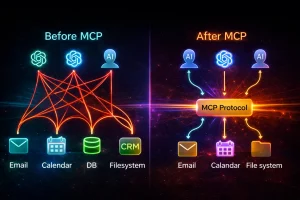
Misconceptions and Myths
Mistake: MCP is just another API
Correction: MCP is a protocol focused on context semantics and lifecycle; APIs are about transport. While MCP can use APIs for transport, conflating the two loses important governance benefits.
Mistake: MCP fixes bad models
Correction: MCP reduces misinterpretation and inconsistent inputs but does not compensate for fundamental model bias or poor training data. It improves reliability, not model quality.
Mistake: MCP is only for chatbots
Correction: MCP is valuable wherever stateful context matters — customer 360, decisioning, and cross-service synchronisation are equally valid use cases.
Mistake: Implementation is prohibitively expensive
Correction: the cost is front-loaded; a focused, schema-driven pilot often pays back through reduced incident load and faster integration for additional products.
Mistake: MCP introduces unacceptable latency
Correction: well-designed MCPs balance pre-validation and lazy-loading strategies; for most enterprise workflows the marginal latency is offset by the reduction in error handling and retries.
Mistake: MCP removes developer flexibility
Correction: it enforces contracts but can be designed to allow extensions and optional fields, preserving innovation while reducing integration debt.
Key Definitions
Context
The set of data points, metadata and state that a model consumes to make an inference or decision in a given interaction.
Protocol
An agreed set of rules and formats for exchanging information; in MCP it refers to conventions for representing and managing context.
Schema
A formal definition of fields, types and semantics used to validate and version context objects.
Lifecycle
Rules that govern creation, update, expiration and archival of context state across time and sessions.
Orchestration
The coordination of multiple models or services to execute a composite task where context must be routed and preserved between components.
Executive Summary
Model Context Protocol (MCP) is a governance and integration protocol that standardises how AI models receive and maintain contextual information. It is most valuable for businesses that deploy stateful or multi-component AI where continuity, auditability and predictable behaviour matter. Implementing MCP reduces operational risk, improves product quality and accelerates scaling by converting ad-hoc context handling into a disciplined, versioned capability. For immediate impact, prioritise MCP pilots on high-frequency, high-cost error flows and ensure cross-functional ownership between product, data and engineering functions. If you operate in regulated industries or at enterprise scale, adopt MCP early in architecture planning to avoid technical debt and to meet compliance needs confidently.
Decision guidance and practical next steps
When to use MCP vs API depends on whether your priority is semantic governance or simple connectivity. If your product requires persistent session knowledge, multi-turn reasoning, traceability or cross-model consistency, implement MCP; for simple stateless exchanges or straightforward CRUD services an API-first approach may suffice. Begin with a lean schema, instrument observability and migrate use cases incrementally rather than attempting enterprise-wide refactors in one step.
Implementation checklist (high-level)
- Identify high-value flows that suffer from inconsistent context.
- Define a minimal viable schema with stakeholders and legal counsel.
- Prototype enforcement and telemetry in a staging environment.
- Run controlled pilots, measure error reduction and operational impact.
- Roll out incrementally and maintain a governance board for schema changes.
Frequently Asked Questions
What is the primary purpose of MCP?
The primary purpose of MCP is to provide a formalised contract for context so AI models receive consistent, versioned and auditable inputs. This reduces misinterpretation, supports compliance and improves operational predictability for model-driven features.
By standardising inputs and enforcing lifecycle rules, MCP reduces noisy or contradictory data reaching models. This improves inference stability, reduces error rates in multi-turn interactions and makes model behaviour more predictable in production.
When to use MCP vs API?
Use MCP when you need durable session state, cross-service context sharing, or regulatory traceability. Use simple APIs for stateless or straightforward data exchanges where semantic governance is not critical. For hybrid systems, combine MCP for context with APIs for transport and service integration.
What are the main implementation risks?
Key risks include added architectural complexity, potential latency impacts if not optimised, governance overhead and the need for cross-team alignment. Mitigate by starting small, measuring impact and automating schema testing and observability.
Yes. MCP is designed to be infrastructure-agnostic and typically integrates with existing APIs and orchestration platforms via adapters and translation layers, enabling incremental adoption without a full platform rewrite.
For businesses that operate internationally, are there localisation considerations?
If you operate in multiple locales, ensure context schemas accommodate language, regional formats and local regulatory constraints. Map cultural nuances and dialect-specific fields explicitly to avoid misinterpretation in downstream models.
How should organisations measure MCP success?
Measure reductions in context-related incidents, improvements in model output consistency, time-to-onboard for new models and operational metrics such as mean time to resolution for context-related bugs. Track compliance and audit-readiness as qualitative outcomes as well.
If our team is small, is MCP worth the investment?
For startups with simple, stateless products, MCP may be premature. However, if your roadmap includes conversational features, personalised experiences or regulated decisioning, implement a minimal MCP early to avoid exponential integration costs later.
Further reading
For perspectives on architecting autonomous agents that rely on stable context, consider enterprise examples such as
🔗 Molt Bot AI, which illustrate trade-offs between stateful agents and platform design principles.