




Estimated reading time: 10 minutes
What is Gamma AI presentation maker?
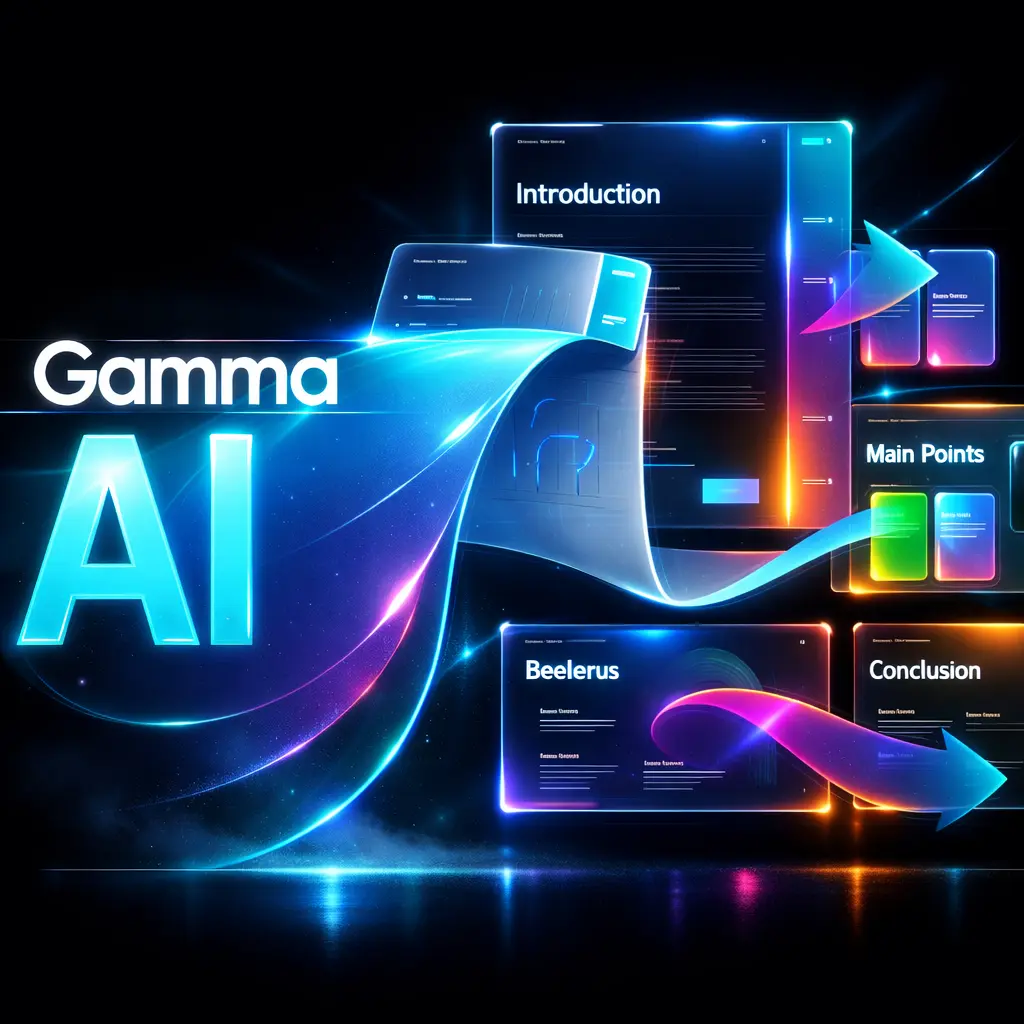
Gamma AI presentation maker is an AI-driven application that automates the creation of slide decks, turning outlines, documents and data into structured, visually coherent presentations within minutes. The tool combines natural language processing, layout intelligence and data visualisation to reduce manual formatting and accelerate delivery of board-ready materials.
The product sits in the category of AI presentation generators and positions itself as an operational productivity layer for communications teams, strategy groups and client-facing functions. It is designed to bridge creative direction and execution by embedding design rules and content hierarchy into an automated workflow rather than replacing designers or strategists.
Gamma emerged to address the recurrent business pain of slow, inconsistent slide production: lengthy formatting cycles, designer bottlenecks and last-minute edits ahead of investor meetings or client pitches. Typical deployments are cloud-based, integrated with content repositories and used by distributed teams preparing strategy reviews, sales decks and product narratives.
For executives the core business value is straightforward: compress time-to-deck, improve consistency of narrative and free senior time for strategic iteration rather than slide mechanics. The tool is most valuable where presentations are frequent, require rapid iteration and must reflect data-driven decisions across functions such as sales, product and marketing.
Key insights
- Gamma applies generative AI plus layout rules to convert text and data into finished slides, reducing manual design time by up to 70% in common workflows.
- Automation focuses on structure and flow—headlines, slide segmentation and data visualisation—so decks are consistently ordered and easier for executives to review.
- Integrations with content sources and export options are business-critical: feeding from spreadsheets, CRMs and analytics platforms makes generated slides operationally relevant.
- Risks include data privacy when processing sensitive inputs, and the potential for homogenised creative output if AI suggestions are accepted uncritically.
- For organisations operating in regulated sectors, governance controls and retention policies must be applied to any AI presentation generator processing confidential information.
Business Problems It Solves
Gamma addresses repetitive, high-cost parts of presentation production that drain time from senior staff and designers. It is primarily a workflow accelerator rather than a creative substitute.
- Time-to-delivery: shortens the drafting cycle for investor updates, sales proposals and executive summaries.
- Consistency and brand control: enforces brand guidelines and slide hierarchy across distributed teams.
- Data-to-story translation: automates chart creation and narrative captioning from raw spreadsheets.
- Operational scalability: removes designer bottlenecks for routine decks, allowing design resources to focus on high-impact pieces.
- Versioning and iteration: streamlines A/B options for messaging and reduces friction in last-minute changes.
Gamma AI presentation maker Features
This section translates key platform capabilities into explicit business outcomes for leaders deciding how the tool fits their operating model.
Automated Slide Generation
Business Value: Converts outlines, documents and brief notes into complete slide decks, cutting drafting time and enabling faster decision cycles. For businesses that run weekly or monthly reporting cadences, this feature materially reduces preparation overhead and speeds up executive review loops.
Intelligent Layout and Design Rules
Business Value: Applies consistent typographic hierarchy, spacing and visual rhythm automatically so every slide meets brand standards without manual checking. This reduces time spent on compliance checks and improves perceived professionalism in external presentations.
Data Visualisation Engine
Business Value: Automatically maps data tables to appropriate chart types, highlights trends and annotates anomalies, which improves decision quality and reduces misinterpretation risk in meetings. For data-driven teams, this accelerates insight-to-action by converting analytics into communicable visuals.
Template and Theme Management
Business Value: Centralises corporate templates and enforces guardrails so local teams produce compliant decks. This lowers risk when scaling messaging to regional offices and supports rapid localisation strategies.
Collaboration and Export Integrations
Business Value: Enables export to common formats and integrates with collaborative editors so teams can hand off AI-generated drafts to subject-matter experts for refinement. Integration with meeting and note systems also closes the loop between creation and follow-up workflows—useful when aligning sales collateral with CRM updates and meeting minutes such as those produced by tools like 🔗 Granola AI Tool.
Versioning and Variant Generation
Business Value: Produces multiple messaging variants and subject-line experiments quickly, enabling rapid market tests and iterated investor narratives without multiplying production cost.
Governance and Access Controls
Business Value: Provides role-based access, audit trails and export restrictions to mitigate compliance risk and protect intellectual property—essential for regulated industries and enterprise deployments.
Gamma AI presentation maker Alternatives and Competitors
Several platforms occupy the same category of AI-assisted presentation creation and differ by focus on automation depth, design intelligence or enterprise integrations.
Beautiful.ai
Beautiful.ai positions itself around design-first automation and is tailored to teams seeking strong visual templates with guided creative constraints. It focuses on designer-friendly automation and slide aesthetics, whereas Gamma emphasises faster conversion from text/data to structured narratives and integrations with analytics pipelines. The contrast matters when choosing for brand-sensitive external presentations versus rapid internal reporting; Beautiful.ai is often chosen for higher-fidelity brand work while Gamma is selected for operational speed. 🔗 Beautiful.ai presentation tool
Canva
Canva is a general-purpose design platform with presentation features and extensive template libraries. It is broadly adopted for marketing collateral and one-off decks; its differentiation is ease of creative control. Organisations prioritising bespoke visual identity often pair Canva with professional design input rather than rely on full automation.
Pitch
Pitch targets collaborative presentation workflows and provides strong versioning and team controls. It is oriented to product and investor communications where synchronous editing and narrative control matter. Pitch’s strategic fit is in companies that value collaborative authoring over fully automated drafting.
Choose Gamma when the priority is rapid conversion of content and data into policy-ready decks and when integrations with analytics or operational systems are required. Choose alternatives when visual customisation or collaborative real-time editing are the dominant selection criteria.
Ready to improve your marketing with AI?
Comparison: Gamma AI presentation maker vs Beautiful.ai
This comparison highlights executive decision factors—automation level, integration potential and best-fit use cases—rather than feature parity.
| Decision Factor | Gamma AI presentation maker | Beautiful.ai |
|---|---|---|
| Primary strength | Automated text-to-deck and data-driven slide creation | Design-led templates with guided aesthetics |
| Automation level | High—optimised for speed and iteration | Moderate—focus on guided design choices |
| Integration with data sources | Strong—built for spreadsheet and analytics workflows | Limited—more template-centred, less data automation |
| Collaboration & export | Export-first with editor handoffs | Real-time collaborative editing |
| Brand control | Centralised templates and governance | High-fidelity visual controls and customisable templates |
| Scalability | Suited to high-volume routine decks | Suited to curated external presentations |
| Best for | Operations, investor updates, analytics-led presentations | Marketing, design-led investor decks, branded pitches |
| Risk profile | Requires careful data governance to manage privacy | Risk of manual inconsistencies if not centrally managed |
In short: select Gamma for throughput and data-to-story automation; select Beautiful.ai for design control and brand polish where appearance is the strategic differentiator.
Misconceptions and Myths
Common misunderstandings can lead to poor deployment choices; the corrections below guide pragmatic adoption.
Mistake: AI will replace presentation designers.
Correction: AI automates routine formatting and first-draft generation but does not replace strategic narrative design or high-end visual craftsmanship. Designers remain essential for complex storytelling and brand differentiation.
Mistake: Generated slides are always accurate.
Correction: AI can misinterpret ambiguous data labels or context; human review is required to validate figures, axis labels and conclusions before external distribution.
Mistake: Using AI removes governance needs.
Correction: AI increases the surface area for governance because it processes content centrally; you still need access controls, audit logs and data retention policies.
Mistake: One-click decks are sufficient for investor meetings.
Correction: Investors evaluate narrative coherence, not just visual polish; AI drafts should be edited to highlight strategic decisions, assumptions and KPIs.
Mistake: AI-generated presentations are indistinguishable from designer work.
Correction: While layouts can be professional, subtle brand cues, bespoke visuals and tailored storytelling still require human craft to achieve standout quality.
Mistake: Faster production means lower cost overall.
Correction: Faster production shifts cost from creation to governance and review; savings accrue most where volume is high and review cycles are streamlined.
Executive Summary
Gamma AI presentation maker is an operationally focused AI presentation generator that accelerates conversion from text and data to structured decks, enforcing consistency while reducing manual effort. For businesses that produce frequent internal reporting, pitch materials or investor updates, Gamma can materially lower production time and free senior staff to focus on substance rather than slide mechanics.
When to use Gamma: if you operate at scale with recurring presentation cadences, require rapid iteration and need integrations to analytics or CRM systems. If your priority is bespoke, brand-first external creative, consider alternatives that emphasise design fidelity. A prudent deployment combines Gamma’s automation for baseline drafts with designer-led refinement for high-stakes external materials.
Key Definitions
Concise definitions to remove ambiguity for executive decision-making.
AI presentation generator
A software system that uses artificial intelligence to produce slide decks from inputs such as text, outlines and data tables, automating layout, visualisation and narrative structure.
Layout intelligence
Algorithms that determine optimal visual arrangement of slide elements—headlines, bullets, images and charts—based on readability, hierarchy and brand rules.
Data visualisation engine
A component that selects chart types, aggregates series and annotates trends automatically to present quantitative information clearly and accurately.
Governance controls
Role-based permissions, audit logs and export restrictions that mitigate risk when AI systems handle proprietary or regulated content.
Variant generation
The automated creation of multiple messaging or slide-layout options to support A/B testing and rapid iteration of strategic narratives.
Frequently Asked Questions
How fast can Gamma produce a usable deck?
Answer: For standard templates and well-structured inputs, Gamma can produce a usable first draft within minutes. The overall time to a board-ready deck depends on review cycles and the depth of data validation required.
Can Gamma handle confidential or regulated data?
Answer: It can, but you must configure governance controls such as on-premise processing, data retention policies and strict access controls. For regulated sectors, run a legal and compliance review before routing sensitive inputs into the system.
What integrations matter most for enterprise use?
Answer: Spreadsheets and BI tools, CRM platforms, and cloud storage systems are the most important integrations because they ensure source-of-truth data feeds into visuals and that generated decks fit existing workflows.
Will using Gamma make our presentations look generic?
Answer: If teams accept default AI suggestions without customisation, there is a risk of homogeneity. Best practice is to use AI for structure and initial visuals, then layer bespoke design and strategic messaging where differentiation matters.
When should a business adopt Gamma?
Answer: Adopt when presentation volume and iteration speed create measurable time waste, or when recurring reporting tasks detract from strategic activities. If the organisation runs frequent investor, sales or executive reviews, Gamma is likely to deliver positive ROI.
How does Gamma support localisation and regional teams?
Answer: Through central template management and theme enforcement it ensures brand consistency while allowing regional teams to input localised text and data. Confirm language support and localisation features during procurement if you operate in non-English markets.
What is the expected ROI model?
Answer: ROI typically appears as reduced hours spent on routine slide preparation, fewer designer gatekeeping costs and faster time-to-decision. Model benefits by estimating labour hours saved per month and the value of accelerated decision cycles.
How should an executive pilot Gamma?
Answer: Start with a focused use case—monthly board packs or standard sales proposals—define acceptance criteria (accuracy, time saved, governance), and run a time-boxed pilot with representative teams to measure operational impact before scaling.