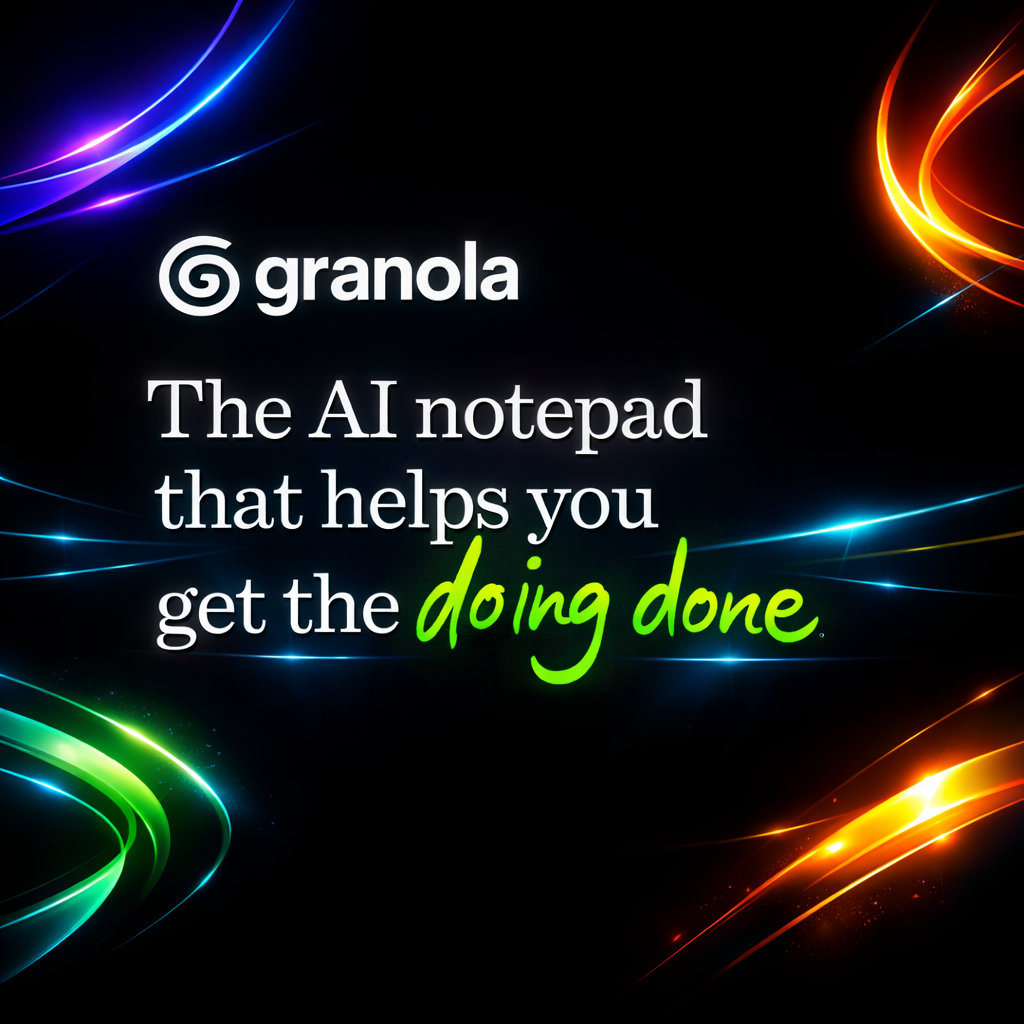
granola ai meeting notes is an AI-driven application that automates transcription and summarisation of live and recorded meetings, producing time-stamped highlights, action items and searchable records. It captures spoken content, identifies speakers where possible, and converts discussions into concise, business-ready outputs suitable for follow-up and decision-making.
The product sits in the meeting intelligence category: software that blends automatic speech recognition (ASR), natural language processing (NLP) and workflow integration to turn conversations into structured knowledge. Its business positioning targets teams and leaders who want to reduce manual note-taking, shorten decision cycles and embed meeting outputs directly into operational systems.
Granola AI emerged to address the operational friction of distributed teams: meetings across Zoom, Teams and Google Meet generate valuable but trapped tacit information. The tool is typically deployed in professional services, product and GTM (go-to-market) teams where meeting outcomes must be captured accurately, assigned and tracked against execution systems.
For executives, the core value is predictable operational leverage: reliable meeting records that reduce follow-up time, improve accountability, and feed CRM, project management and analytics pipelines. It is most valuable where meetings are a primary input to revenue, product decisions or regulatory processes and where repeatable, auditable records materially improve outcomes.
Key insights
Automated transcription and summarisation reduce time spent on documentation by 40–70% when integrated into standard meeting workflows.
Time-stamped notes and speaker labelling transform meetings from ephemeral events into searchable organisational knowledge assets.
Integration depth (CRM, project tools, calendar) is the single biggest determinant of business value, often outweighing marginal accuracy differences.
Accuracy degrades on domain-specific jargon and multi-accent environments; feedback loops and custom vocabularies materially improve quality.
Privacy, data residency and compliance requirements are common procurement blockers for enterprise adoption.
Business Problems It Solves
The tool addresses inefficiencies in capturing, distributing and actioning meeting outputs, which frequently cause delayed decisions and lost information.
Lost verbatim context: replaces unreliable memory and fragmented notes with an authoritative record.
Slow execution: converts decisions into tasks and assigns owners automatically, reducing manual handoffs.
Poor knowledge re-use: makes prior discussions searchable and reusable for onboarding, audits and retrospectives.
Visibility gaps: provides managers and remote stakeholders with concise meeting summaries to support strategic oversight without attending every meeting.
Granola AI Tool for Meeting Notes Features
This section maps core technical capabilities to executive outcomes so leaders can assess strategic fit.
Automatic Transcription
Business Value: Converts spoken content into accurate, time-stamped text that becomes the single source of truth for decisions and compliance, reducing disputes and rework while enabling indexing for knowledge retrieval.
AI Summaries and Highlights
Business Value: Distils long conversations into executive summaries, decisions, and action items; this accelerates decision cycles, improves meeting ROI and reduces time wasted rereading full transcripts.
Speaker Identification and Attribution
Business Value: Assigns accountability by linking statements and action items to identifiable speakers, which supports performance tracking, follow-up automation and audit trails.
Action Item Extraction and Task Integration
Business Value: Automatically generates tasks and pushes them to project management systems or CRMs, ensuring decisions lead to measurable execution and reducing manual task creation errors.
Searchable Meeting Knowledge Base
Business Value: Indexes conversations to support faster onboarding, cross-team knowledge sharing and post-meeting analytics, improving operational repeatability and reducing redundant meetings.
Custom Vocabulary and Domain Tuning
Business Value: Improves transcription accuracy for industry-specific terms—critical for sales, legal, and technical discussions—minimising correction overhead and preserving signal in specialist conversations.
Integrations and APIs
Business Value: Enables seamless embedding of meeting outputs into CRM, analytics and automation stacks, turning conversations into actionable data streams that support revenue and product workflows.
Main Strategic Use Cases
Granola AI translates meeting activity into strategic playbooks and operational outputs for revenue, product and compliance functions.
Sales: create quotable call summaries, surface objections and next steps automatically, and populate CRM fields to shorten sales cycles.
Product: capture feature requests, user pain points and prioritised decisions to feed product backlogs and roadmaps.
Customer Success: produce service recovery records and action plans to improve retention and NPS (net promoter score).
Executive Briefing: generate concise board-ready summaries from cross-functional meetings to enable faster executive decisions.
Presentation generation: export structured summaries into slide-ready formats when transforming meeting outcomes into stakeholder presentations using a presentation tool such as 🔗 Beautiful.ai presentation tool.
Ready to improve your marketing with AI?
Let’s discuss how AI workflows and agents can save hours every week, lower acquisition costs, and upgrade the quality of your marketing execution.
Get Free Consultation
Business Operations Use Cases
Operations teams apply the tool to drive consistency in execution and reduce manual coordination costs.
Programme management: synchronise meeting decisions with project plans and automatically update timelines.
HR and onboarding: create searchable archives of training and one-to-one meetings to accelerate learning curves.
Legal and compliance: retain auditable records of critical conversations to meet audit requirements and support dispute resolution.
Granola AI Tool for Meeting Notes Alternatives and Competitors
Decision-makers should evaluate direct competitors on accuracy, integration depth, pricing model and enterprise controls.
Fireflies
Fireflies positions itself as an accessible meeting assistant with broad integrations and competitive pricing; it emphasises ease of use for SMBs and has a large user base. Strategically, Fireflies focuses on rapid deployment and generalist functionality rather than deep domain tuning.
Otter.ai
Otter.ai is strong on ASR accuracy and has been widely adopted for note-taking and teaching contexts; it prioritises consumer and enterprise tiers and differentiates through robust live transcription and team libraries.
Gong
Gong is a revenue intelligence platform that uses conversation analysis for sales optimisation, offering deeper analytics and coaching workflows; it is more expensive and oriented towards scaling revenue teams rather than general meeting capture.
Fathom
Fathom focuses on lightweight meeting capture with simple summarisation and CRM integrations, positioned for modern SaaS teams that want minimal setup and fast ROI.
When to choose Granola AI over alternatives
Choose Granola AI when you need a balance of accurate summaries, enterprise-grade integrations and a workflow-first approach that converts discussions directly into tasks and CRM updates. If your priority is deep sales coaching analytics, a specialised revenue tool like Gong may be preferable; if you want a no-friction consumer experience, Otter or Fathom could be more appropriate.
Comparison: Granola AI Tool for Meeting Notes vs Fireflies
This section highlights the decision factors CFOs, CMOs and founders evaluate when choosing between the two.
Granola AI
Fireflies
Accuracy and domain tuning
Supports custom vocabularies and domain adaptation for specialist terminology.
Strong general ASR accuracy but fewer advanced domain-tuning features.
Integration depth
Designed to push actions and summaries into CRMs and PM tools with robust APIs.
Good integrations with mainstream tools; may require manual workflows for complex automation.
Workflow automation
Focuses on automatic action-item extraction and task creation to reduce manual handoffs.
Offers export and sharing; automation often relies on third-party connectors.
Pricing model
Typically tiered for enterprise needs with add-ons for advanced compliance and storage.
Competitive SMB-friendly pricing and freemium options for rapid adoption.
Enterprise controls
Includes data residency and governance options suitable for regulated environments.
Standard enterprise features available, but some customers require additional governance controls.
Strategic value
Best when the goal is to convert meeting outputs into automated operational workflows and auditable records.
Best for teams needing lightweight capture and broad accessibility across users.
Benefits & Risks
Understanding both upside and constraints is essential for procurement and governance decisions.
Benefits: increased execution speed, better knowledge retention, measurable reduction in administrative overhead, and improved accountability through speaker attribution and tasking.
Operational risk: over-reliance on automated summaries can obscure nuance—human review remains necessary for legal and high-stakes decisions.
Privacy and compliance: storing conversations can trigger data protection obligations; procurement must validate data handling, retention policies and localisation options.
Connectivity and availability: as a cloud-first service, performance depends on reliable internet and vendor uptime guarantees.
Contrarian perspective: companies that prioritise near-perfect accuracy for high-stakes legal or clinical meetings may find human transcription or hybrid workflows more cost effective than striving for end-to-end automation; the optimal model is often hybrid—machine-first capture with targeted human review.
Misconceptions and Myths
Mistake: AI meeting notes replace human minutes entirely.
Correction: AI accelerates capture and draft generation, but humans must validate conclusions, clarify ambiguous statements and confirm action ownership in complex or regulated contexts.
Mistake: All meeting intelligence products have the same accuracy.
Correction: Accuracy varies with ASR engine, domain tuning, and speaker conditions; bespoke vocabularies and training materially improve outcomes for specialist teams.
Mistake: Transcripts are just for record-keeping.
Correction: Transcripts become data assets when integrated into analytics, CRM fields and knowledge graphs, enabling predictive insights and repeatable playbooks.
Mistake: Using automated tools eliminates privacy concerns.
Correction: Automated capture increases surface area for data exposure; governance and contractual controls are necessary to manage risk and regulatory compliance.
Mistake: Implementing meeting AI is plug-and-play and always yields immediate ROI.
Correction: Real ROI depends on integration quality, user adoption, training and feedback loops; pilot projects and change management are usually required.
Mistake: Language localisation isn’t a major concern.
Correction: Regional accents and non-English languages require evaluation; performance gaps can erode trust and reduce adoption in multilingual teams.
Executive Summary
For executives deciding whether to adopt meeting intelligence, Granola AI converts conversation into operational value by automating capture, summarisation and tasking while providing integration points into CRM and project tooling. It is most valuable for teams where meetings drive revenue, product decisions or regulatory evidence and where the incremental cost of automation is offset by faster execution and fewer follow-ups.
When to use Granola AI: deploy when meeting volume is high, follow-ups are frequent, and decision traceability improves commercial or operational outcomes. If you operate in regulated industries, prioritise vendors that offer data residency and governance controls. For businesses that need deep coaching analytics, consider a revenue-intelligence tool as a complement rather than a replacement.
Key Definitions
Automatic Speech Recognition (ASR)
Technology that converts spoken language into text; ASR performance is measured by word error rate and is the foundational layer for meeting capture.
Natural Language Processing (NLP)
Algorithms that interpret and extract meaning from text, enabling summarisation, action-item extraction and intent detection from meeting transcripts.
Action-item Extraction
Automated identification of tasks, owners and deadlines from a conversation, often using pattern recognition and modelled business rules.
Data Residency
Requirement that stored data remain within a particular geography or jurisdiction to meet legal or regulatory standards.
Conversation Intelligence
A broader category that combines transcription, analytics and coaching to derive commercial insights from spoken interactions.
Speaker Diarisation
The process of segmenting audio to identify and label different speakers, enabling accurate attribution of statements and decisions.
Frequently Asked Questions
How accurate are automated meeting transcripts?
Accuracy varies by audio quality, accents and domain vocabulary. Expect general accuracy sufficient for summarisation in many settings, but plan for human review in technical or regulated meetings and invest in custom vocabularies to improve results.
When to use automated notes versus human minutes?
Use automated notes for operational meetings, recurring check-ins and sales updates where speed matters. Use human minutes for legal, contractual or highly nuanced discussions where interpretative judgement and precise wording are essential.
Can the tool integrate with our CRM and project tools?
Yes, most vendors provide native integrations or APIs to push summaries, tasks and CRM fields. For enterprise deployments, validate connector capabilities, field mappings and error handling during procurement.
What are the main privacy and compliance considerations?
Key considerations are consent for recording, data retention policies, encryption in transit and at rest, and data residency. If you operate in regulated industries or specific jurisdictions, require contractual guarantees and audit capabilities from the vendor.
How should we pilot the tool to measure ROI?
Run a time-boxed pilot with clear KPIs: reduction in action follow-up time, percentage of meetings with assigned tasks, and user satisfaction. Include technical validation of integration flows and a feedback loop for transcript correction and vocabulary tuning.
Is language support sufficient for non-English meetings?
Language support varies; evaluate on sample recordings with local accents and domain terminology. If you operate in multilingual regions, request vendor performance reports and options for on-premise or regional hosting.
How does Granola AI compare to Fireflies in pricing and deployment?
Fireflies often offers lower friction and competitive pricing for SMBs, while Granola AI typically presents tiered enterprise plans with advanced integrations and governance. Choose based on integration needs, compliance requirements and expected scale.
What governance controls should we require from vendors?
Insist on encryption, access controls, audit logs, role-based permissions, data deletion policies and contractual clauses for data processing. For enterprise procurement, map these controls to internal risk frameworks and legal requirements and consider independent audits.
Practical tip for regional deployments
If you operate in regions where language accuracy or data residency matter, include representative recordings in vendor trials, request transparent model performance metrics for local languages, and evaluate options for localised hosting or hybrid on-premise connectors. For marketing teams looking to extract shareable clips and repurpose meeting content into external assets, consider workflows that link meeting outputs to content pipelines such as those used to 🔗 repurpose video content.
Operational governance and context protocols
Enterprises should codify how meeting data is used and shared; adopt a context governance framework that specifies retention, access and audit processes to avoid accidental leakage and ensure auditability. Implementing a formal 🔗 Model Context Protocol helps align ML model usage with organisational policy.
Category :
AI Tools
Share This :
Posted On :
April 8, 2026
Author:INNA CHERNIKOVA
Marketing leader with 12+ years of experience applying a T-shaped, data-driven approach to building and executing marketing strategies. Inna has led marketing teams for fast-growing international startups in fintech (securities, payments, CEX, Web3, DeFi, blockchain, crypto), AI, IT, and advertising, with experience across B2B, SaaS, B2C, marketplaces, and service providers.
Contact us to collaborate on personalized campaigns that boost efficiency, target your ideal audience, and increase ROI. Let’s work together to achieve your digital goals.