


Estimated reading time: 17 minutes
What is Workspace agents in ChatGPT?
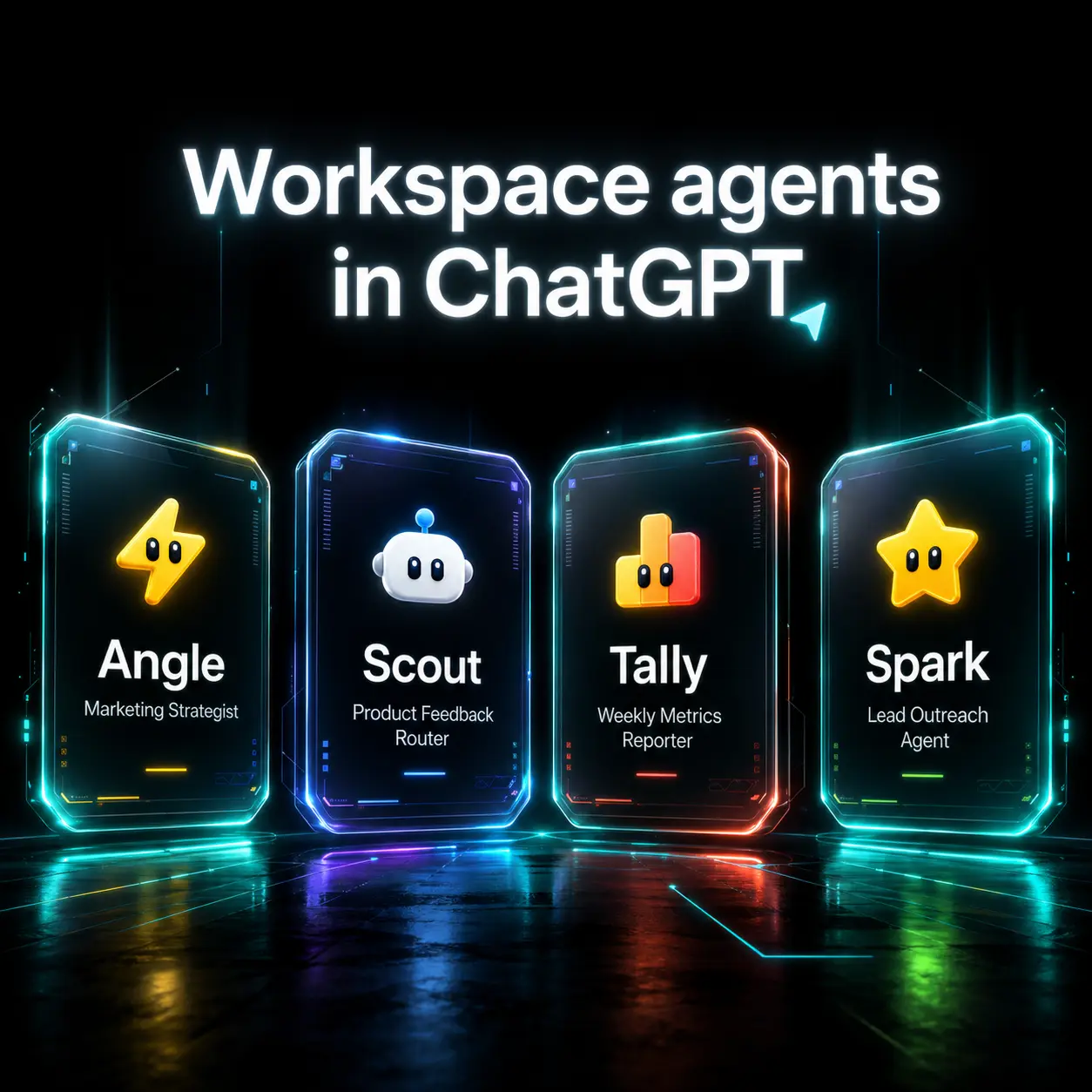
Workspace agents in ChatGPT are purpose-built conversational agents configured inside a shared ChatGPT workspace to automate tasks, orchestrate workflows and respond to role-specific queries for teams. They act as configurable assistants that combine language understanding with integrations to other systems, enabling repeatable actions and informed responses for business users.
Technically, this capability sits in the category of agent platforms and conversational automation within a generative AI environment: an enterprise-facing layer on top of a large language model (LLM) that blends prompting, stateful memory, tool access and role-based configuration. It positions ChatGPT as more than a chat tool — it becomes a governance-aware execution layer for knowledge work.
The concept originated as part of the evolution from single-session conversational assistants to persistent, workspace-centred automation. Typical environments are collaborative teams, product groups and operations units where agents are provisioned inside a secure workspace, granted controlled access to data sources and linked to task automation or external APIs for end-to-end activities.
Strategically, the primary value is operational leverage: reducing manual effort, accelerating decision loops and standardising interactions across customer support, sales enablement, analytics and knowledge management. Executives should view these agents as modular automation assets that scale expertise, codify institutional know-how and unlock faster throughput across repeatable business processes.
ChatGPT Workspace Agent Key insights
- Workspace agents convert prompts into repeatable workflows by combining a model with integrations and workspace state.
- ChatGPT Workspace Agent reduce routine labour—such as triage, summarisation and template-driven communications—freeing senior staff for higher-value work.
- Customisation enables role-specific language, constraints and data access, improving relevance for domain teams.
- Risk management depends on access controls, audit trails, and careful configuration to avoid data leakage and automation errors.
- Adoption requires process redesign: agents are most valuable when embedded in existing systems and KPIs, not used as standalone toys.
Business Problems It Solves
Workspace agents resolve operational bottlenecks that stem from repetitive knowledge work, inconsistent customer responses and slow information retrieval across teams.
- Customer-service load: agents handle first‑line inquiries, surface relevant knowledge base articles and escalate only complex cases.
- Knowledge fragmentation: they consolidate dispersed documents and create consistent, summary-level answers for decision makers.
- Sales and marketing enablement: agents generate tailored proposals, briefings and campaign copy using standard templates and up-to-date data.
- Analytics triage: agents prepare data summaries, annotated insights and next-step recommendations for analysts and executives.
Workspace agents in ChatGPT Features
Workspace agents in ChatGPT include configurable access, tool integration, memory and role-aware prompts that convert to business outcomes.
Role-based Configuration
Business Value: Role-based configuration ensures agents speak the appropriate tone and use role-relevant data, reducing rework and improving customer or stakeholder fidelity when scaling across teams.
Tool and API Integrations
Business Value: Connecting agents to CRMs, ticketing systems, analytics and document stores automates end-to-end tasks and eliminates context-switching, which accelerates response times and improves process throughput.
Persistent Workspace Memory
Business Value: Memory preserves context across interactions, enabling agents to maintain project state, follow-up actions and institutional learning—this increases accuracy for ongoing workflows and reduces duplicated effort.
Pre-built Workflow Templates
Business Value: Templates translate best-practice processes into quick-start automations for support triage, buyer outreach, compliance checks and reporting, shortening time-to-value for teams deploying agents.
Audit Trails and Governance Controls
Business Value: Built-in logging and permissioning provide visibility for compliance and risk teams, making agents suitable for regulated environments by enabling traceability and controlled data access.
Natural-Language to Action Mapping
Business Value: Translating intent expressed in natural language to concrete system actions reduces training overhead and lets non-technical staff trigger complex processes reliably, improving operational agility.
Main Strategic Use Cases
Workspace agents are strategic levers for automating knowledge-intensive processes and scaling expertise across customer-facing and internal operations.
Customer Support Automation
Agents provide immediate answers, propose ticket tags, retrieve order history and recommend next steps; when to use them: use agents for high-volume, predictable enquiries and to improve SLAs while preserving human oversight for exceptions.
Sales Enablement and Proposal Generation
For businesses that prioritise fast, personalised outreach, agents generate tailored proposals from CRM data, produce briefing notes and surface competitive intelligence to accelerate deal cycles.
Insight Production for Executives
If you operate in data-rich environments, agents synthesise reports, create executive summaries and propose strategic options, shortening the decision loop between analysts and C-suite.
Ready to improve your marketing with AI?
Let’s discuss how AI workflows and agents can save hours every week, lower acquisition costs, and upgrade the quality of your marketing execution.
Business Operations Use Cases
Operationally, agents embed into routine processes to standardise outputs and reduce manual touchpoints.
- IT and DevOps: automating runbook queries, incident triage and routine maintenance checks.
- HR and People Operations: screening candidate summaries, answering policy queries and onboarding checklists.
- Finance: preliminary variance analysis, invoice triage and automated reconciliation prompts.
- Legal and compliance: first-pass contract review, clause extraction and compliance checklists for routine contracts.
Marketing Use Cases
Marketing teams use agents to scale content production, accelerate campaign planning and maintain brand consistency.
- Content ideation and repurposing: agents generate briefs, repurpose long-form content into social posts and produce multi-channel outlines quickly.
- Advertising and monetisation alignment: agents can be configured to follow advertising policies and generate ad copy; publishers should consider emerging platform features such as 🔗 OpenAI Launches Advertising when designing monetised conversational experiences.
- Campaign performance synthesis: agents summarise metrics and suggest optimisation priorities aligned with KPIs.
- Brand governance: enforce tone and messaging templates to reduce off‑brand variations across channels.
How Workspace Agents Work (Executive Setup)
At an executive level, agents operate by combining a language model, configuration, integrations and governance into a single, workspace-centred automation layer.
- Define intent and scope: specify the business process, success metrics and escalation points.
- Map data sources and permissions: connect only the necessary systems and set role-based access.
- Design prompts and templates: encode domain rules, brand voice and failure-handling policies.
- Integrate tools and actions: connect APIs for CRM, ticketing or analytics to enable real actions, not just responses.
- Test and iterate with audits: run supervised pilots, capture logs and refine behaviour before broad rollout.
Workspace agents in ChatGPT Alternatives and Competitors
There are several vendors competing in the agentic workspace and autonomous agent market, each with distinct strategic positioning.
Claude Cowork
🔗 Claude Cowork is Anthropic’s agentic workspace offering that emphasises safety and constitutional constraints; it appeals to organisations prioritising conservative guardrails and model behaviour control versus rapid feature expansion.
Manus AI Agent
🔗 Manus AI Agent positions itself as an autonomous enterprise workflow platform focused on complex, multi-step automation; it targets integration-heavy enterprise workflows where orchestration across many systems is critical.
Molt Bot AI
🔗 Molt Bot AI is presented as a self-hosted autonomous agent solution, appealing to organisations that require on-premise control and custom execution environments rather than a hosted workspace model.
Choose the main workspace-agent model when you need tight integration with ChatGPT’s ecosystem and a balance of ease-of-use and governance; consider alternatives when your priority is on-premise control, deep orchestration or specific safety frameworks.
Comparison: Workspace agents in ChatGPT vs Claude Cowork
This comparison highlights differences relevant to vendor selection and strategic fit for enterprise deployments.
| Decision Factor | Workspace agents in ChatGPT | Claude Cowork |
|---|---|---|
| Integration with OpenAI ecosystem | Native, fast access to ChatGPT models, prompting and workspace UI. | Requires connectors; focuses on Anthropic model family and safety layers. |
| Governance and safety | Role-based permissions, logging and configurable policies; governance is provider-dependent. | Designed with conservative behaviour constraints and explicit constitutional guardrails. |
| Enterprise orchestration | Strong for teams using cloud APIs and common SaaS integrations; easier for rapid deployments. | Better suited to organisations needing stricter model-behaviour controls and tailored safety frameworks. |
| Deployment options | Hosted workspace model with managed updates and cloud dependencies. | Hosted with enterprise options; varies by vendor contract and integration approach. |
| Scalability | Scales via workspace and API usage; cost scales with requests and integrations. | Scales with emphasis on safe scaling; pricing and throughput dependent on contract. |
Misconceptions and Myths
Mistake: Agents will replace domain experts overnight.
Correction: Agents automate repeatable tasks and augment experts, but they require governance, oversight and domain validation to be reliable; subject-matter experts remain essential for complex judgement calls.
Mistake: Agents are plug-and-play for every process.
Correction: Value depends on process fit, data quality and integration effort; many deployments need iteration, prompt engineering and change management.
Mistake: All agents are identical across vendors.
Correction: Vendors differ in safety models, integration depth, deployment options and governance features; choose based on strategic priorities.
Mistake: Agents eliminate compliance risk.
Correction: They introduce new governance requirements; without proper access controls and audit logs, agents can increase data exposure risk.
Mistake: A single agent solves multiple unrelated workflows well.
Correction: Agents perform best when scoped; attempting to address broad, unrelated workflows with one agent increases error rates and maintenance overhead.
Benefits & Risks
Workspace agents deliver scale and consistency but introduce operational and governance risks that need active management.
- Benefits: efficiency gains, standardised communication, 24/7 responsiveness, faster decision cycles and codified institutional knowledge.
- Risks: data leakage, misconfiguration, model hallucinations, over-dependence by staff and latent bias in outputs.
- Mitigations: least-privilege access, human-in-the-loop checkpoints, robust logging, periodic audits and clear SOPs for escalation.
Executive Summary
Workspace agents in ChatGPT are modular automation assets that convert conversational intent into repeatable workflows by combining LLM-driven understanding with integrations, memory and governance. For CEOs and CMOs, the strategic opportunity is operational leverage: agents reduce routine labour, standardise customer and internal interactions and speed up decision cycles, while allowing organisations to codify and scale critical expertise.
When to use agents: implement them for high-volume, repeatable tasks, as decision-support for analytics and as productivity multipliers for sales and marketing teams. If you operate in regulated sectors, prioritize agent configurations with strong audit, access controls and clear escalation paths. For businesses that require on-premise control or deep orchestration, evaluate alternatives that offer self-hosting or enterprise-grade workflow engines before committing to a hosted workspace model.
Key Definitions
Agent
A software component that uses language understanding and connected tools to perform tasks, answer queries or trigger workflows on behalf of users.
Workspace
A shared environment where teams configure agents, control access, connect data sources and manage deployments within a common governance model.
Memory
Persistent state that an agent retains across interactions to maintain context, preferences and project history for more coherent responses.
Tool Integration
A connection between an agent and an external system (for example a CRM or ticketing platform) that enables actions beyond text generation.
Human-in-the-loop
A governance pattern where humans review, approve or override agent outputs to manage risk and ensure quality in critical workflows.
Frequently Asked Questions
How do I decide which processes to automate with agents?
Prioritise processes that are high-volume, rule-based and require frequent information retrieval or templated outputs. If you operate in areas with clear escalation thresholds and measurable KPIs, those processes are good candidates for early pilots.
Can agents access sensitive customer data safely?
Yes, but only with strict controls: apply least-privilege access, encryption in transit and at rest, audit logs and role-based permissions. For regulated data, ensure contractual and technical safeguards align with compliance requirements.
What governance controls should be in place before scaling agents?
Implement access controls, logging, versioned prompt templates, human-review checkpoints and incident response procedures. Regularly audit outputs and maintain a changelog for prompt and integration updates.
How quickly can businesses see ROI from agents?
Small pilots delivering triage, summarisation or templated communication tasks can show measurable time savings within weeks; enterprise-wide transformation with deep integrations will show ROI over quarters as processes stabilise.
When should we choose a self-hosted agent vs a hosted workspace?
Choose self-hosted when data residency, latency or custom execution environments are critical. For rapid deployment and lower operational burden, hosted workspaces usually deliver faster time-to-value.
Do agents replace the need for training staff?
No. Agents augment staff by reducing routine work, but successful adoption requires training, change management and new operating procedures to integrate agents into daily workflows.