



Estimated reading time: 22 minutes
What Is a Content Writer for SaaS
If you are looking for a content writer for SaaS, the real business question is not whether someone can write a good article. It is whether your content operation can win visibility, educate buyers, and create pipeline at the pace the market now demands. SaaS is a large and fast-moving category, with cloud application spending projected by Gartner to reach about $299 billion in 2025. In that environment, content is not a publishing task; it is a revenue channel.
AI search has changed the rules. SaaS buyers now use Google, AI Overviews, ChatGPT, Perplexity, Gemini, and similar tools to compare software, evaluate alternatives, and shortlist vendors before they speak to sales. That means your content must do more than rank in search. It must also show up in AI-generated answers, cover more buyer questions, and publish faster than competitors. Octogamma, a senior marketing agency for tech, fintech, SaaS, and Web3 companies, helps businesses do exactly that with strategic marketing services and marketing products built for measurable growth.
This guide explains how to move from hiring a single writer to building an SEO + GEO content engine. You will learn what a traditional SaaS writer can do, what they usually miss, and how Octoblogger AI Article Writer OS can turns fragmented topics into CMS-ready content designed for search visibility, buyer education, and operational scale.
What SaaS Brands Need for Strong Content
Before you try to scale content, you need clarity on three things: your ideal buyer, your priority topics, and your commercial objectives. SaaS content performs best when it is mapped to real buying intent, not written as a generic blog calendar.
- Business goal: Are you trying to generate demand, support sales, reduce CAC, or improve organic acquisition?
- Buyer definition: Who is searching, and what stage of the journey are they in?
- Topic map: Which pain points, comparisons, use cases, integrations, and pricing questions matter most?
You also need a clear view of your current production bottlenecks. If your team is slow because research, SEO review, editing, formatting, and CMS upload all happen separately, a better writer alone will not solve the problem.
How AI Search Changed SaaS Content Production
Search is no longer just about blue links in Google. Google has stated that AI Overviews and AI Mode are rooted in core Search ranking and quality systems, and that query fan-out is used to expand a question into related searches. In practical terms, this means SaaS brands need topical coverage, not isolated articles. One page is rarely enough to answer the full commercial intent behind a software query.
For a SaaS business, that changes the role of the writer. A strong SEO content writer for SaaS must create content that can perform in classic organic search and also feed AI-generated summaries with useful, structured, and trustworthy information. Google also makes it clear that valuable, non-commodity content matters more in generative search, and that AI-assisted content is acceptable when it is helpful, original, and people-first. What Google penalises is low-value automation used mainly to manipulate rankings.
This is why SaaS content now needs both SEO and GEO. SEO helps you rank in traditional search results. GEO, or generative engine optimisation, helps your content become more visible in AI-generated answers. If your content engine does not cover the full topic cluster, you will lose visibility to competitors that publish broader, clearer, and more consistent coverage.
Why SaaS Content Production Must Scale
SaaS buyer behaviour is highly fragmented. People do not just search for your product name. They search for pain points, integrations, alternatives, competitor comparisons, pricing questions, templates, onboarding guides, industry-specific use cases, and “best software” queries. Gartner has also reported that 75% of B2B buyers prefer a rep-free sales experience, which means digital content has to frame and affirm value before a sales conversation happens.
That is why one or two articles per month rarely move the needle. A b2b SaaS content writer can produce quality writing, but SaaS growth depends on how many buyer questions you cover and how quickly you cover them. If your competitor publishes comparison pages, integration pages, use-case pages, and problem-led content across the funnel, they will capture demand from multiple angles while your team stays stuck on a narrow blog cadence.
Content volume matters because SaaS search demand is distributed across many keyword patterns. Buyers do not move in a straight line. They explore features, benchmark against alternatives, check implementation fit, and look for proof. A content strategy that only covers top-of-funnel blog posts leaves revenue on the table.
Where SaaS Writers Fall Short
A capable writer can produce a solid article. The gap is not writing quality alone. The gap is production design. SaaS growth requires a system that combines research, search intent mapping, internal linking, metadata, GEO structure, localisation, formatting, and CMS delivery.
In other words, a content writer for SaaS writes words, but a content engine creates distribution-ready assets. That distinction matters because the commercial value of content depends on whether it can be published quickly, indexed cleanly, and reused across the buying journey. If your operation depends on manual coordination, your output will always be limited by human capacity rather than market opportunity.
- Research: Identify commercial intent, topical gaps, and buyer questions.
- SEO strategy: Match keywords to search intent and content type.
- GEO structure: Make content easy for AI systems to interpret and cite.
- Formatting: Deliver readable, skimmable, CMS-ready content.
- Delivery: Publish at the pace required to compete.
Ready to improve your marketing with AI?
Let’s discuss how AI workflows and agents can save hours every week, lower acquisition costs, and upgrade the quality of your marketing execution.
Why Content Agencies Slow SaaS Growth
Traditional SaaS content agencies often create quality work, but their workflow is slow by design. A brief goes to a writer, then to an editor, then to SEO review, then to client review, then to formatting, then to upload. Each hand-off adds time, cost, and potential inconsistency.
The business problem is not only speed. It is coordination overhead. Every extra stage increases the likelihood of missed intent, inconsistent SEO execution, delayed publication, and content that arrives after the market opportunity has shifted. For a founder or CMO, that means slower learning cycles and weaker organic momentum.
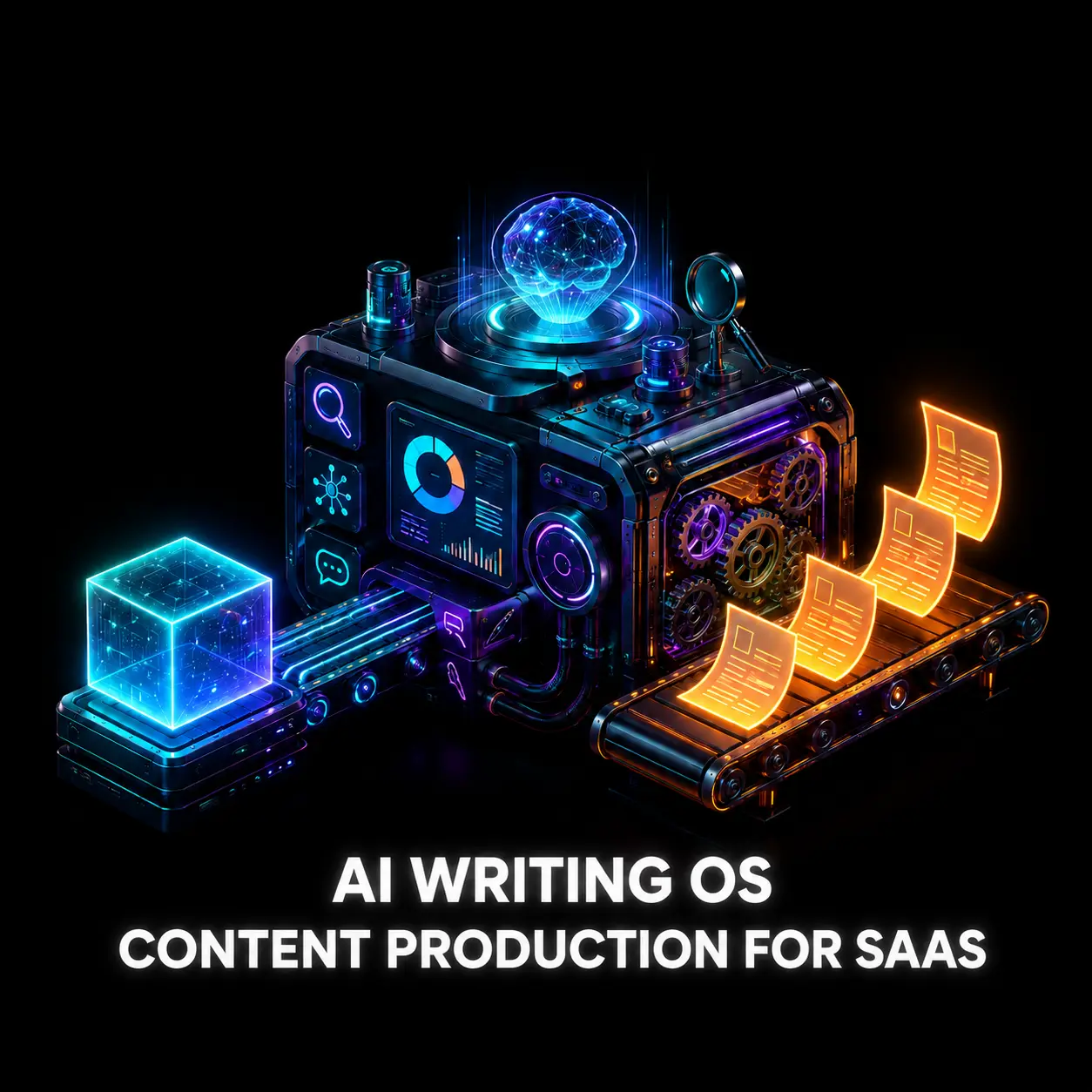
Octogamma addresses this through Octoblogger, an AI Article Writer OS that replaces slow manual content production with scalable, optimised, CMS-ready SaaS content. It is not a ChatGPT wrapper. It is a full-stack content production system built to turn a topic into a researched, SEO- and GEO-ready article in minutes.
Content Writer for SaaS vs Octoblogger
The right comparison is not human versus machine. It is writer-led production versus system-led production. If your goal is measurable output at scale, the system matters more than the individual article.
| Category | Traditional SaaS Writer / Agency | Octoblogger |
|---|---|---|
| Speed | Days or weeks per article | Around 3 minutes per article |
| Cost | Writer, editor, SEO, manager, CMS upload | Reduces production cost by up to 85-95% |
| SEO | Depends on writer and editor skill | SEO built into the workflow |
| GEO | Usually missing | Optimised for AI search visibility |
| Scale | Limited by human capacity | Runs 24/7 |
| Localisation | Expensive and slow | Multilingual localisation built in |
| CMS | Manual formatting and upload | CMS-ready / direct publishing |
| Consistency | Varies by writer | Repeatable 23-step workflow |
How Octoblogger AI Writer OS Scales SaaS Content
Octoblogger is designed for speed without sacrificing structure. It accepts a topic, URL, keyword, note, voice message, or content plan and converts that input into a researched article with SEO and GEO structure, humanisation, localisation, and formatting built in.
The operational value is simple: topic in, SEO + GEO-ready article out. That matters for SaaS teams because it removes the production bottleneck. Instead of spending time coordinating briefs, drafts, rewrites, and uploads, your team can focus on positioning, approvals, and distribution.
- 23-step workflow: Built to systemise research, optimisation, and formatting.
- Deep topic research: Captures buyer intent and semantic coverage.
- Semantic gap analysis: Identifies missing angles competitors may ignore.
- 85%+ humanisation: Makes output more natural and readable.
- Multilingual localisation: Supports international SaaS growth.
- CMS-ready delivery: Reduces manual publishing work.
- 24/7 production: Supports always-on content operations.
This is where modern SaaS content operations become commercially meaningful. A system that can produce consistent, optimised content at speed gives marketing teams more shots on goal across the funnel.
Scale Content Production for Your SaaS
Without Scaling Your Team
Replace slow briefs, writing, SEO and GEO checks, formatting, and CMS upload with an AI Article Writer OS built for high-volume content production.
Where SaaS Content Drives Revenue
A B2B SaaS content writer supports buyer education, but the content must also shape pipeline. Buyers often arrive well informed and with a shortlist already in mind. Your job is to be present at every decision point.
For example, product comparison pages can capture high-intent traffic from prospects evaluating alternatives. Integration pages can target operational fit. Feature explainers can reduce objections. Industry landing pages can show relevance. Onboarding content can improve retention by helping customers adopt faster. Together, these assets support both acquisition and expansion.
That is why SaaS content should be treated as part of the revenue system, not as a separate creative function. The more clearly your content maps to buyer questions, the more efficiently it supports pipeline creation and sales enablement.
Best SaaS Content Use Cases
Octoblogger is most valuable when your SaaS brand needs breadth, consistency, and speed across many commercial content types. It is especially useful when your market requires repeated coverage of similar themes in different formats.
- Alternative pages
- Competitor comparison pages
- Integration pages
- Use case pages
- Pain-point blog posts
- Feature explainers
- Industry landing pages
- Glossary pages
- Template articles
- Onboarding content
- Multilingual SEO clusters
For teams already investing in broader digital strategy, Octoblogger can also support adjacent workflows such as video repurposing and campaign content production, similar to the automation approach used in video content repurposing. The strategic point is the same: turn one source of truth into multiple publishable assets with minimal friction.
How to Build SaaS Content Production Workflow
1. Define the commercial goal
Start by deciding what the content must achieve. Is it organic traffic, demo requests, product education, or category authority? If you do not define the commercial outcome, you will measure volume instead of value.
2. Map the buyer questions
Build a topic map around the full SaaS buying journey. Include pain points, alternatives, comparisons, pricing, integrations, implementation, and proof. This is how you move from random publishing to structured demand capture.
3. Assign the right content type
Choose the page format that matches search intent. A comparison query needs a comparison page. A problem query needs a pain-point article. A use-case query needs a solution-led page. The format must fit the intent, not the other way round.
4. Build the SEO and GEO brief
Include target keyword, supporting terms, internal links, buyer stage, product claims to avoid, and any localisation needs. This is where the difference between a simple draft and an operational asset begins.
5. Generate and refine the draft
Use a system that can produce the first draft quickly, then refine for accuracy, tone, and product fit. Octoblogger uses structured research and optimisation rather than generic prompting, which is why it can produce CMS-ready output instead of rough copy.
6. Review, approve, and publish
Human review should confirm product accuracy, positioning, proof points, and compliance. The team retains strategic control, while the system handles the repetitive production work. That is how SaaS teams scale without adding a larger content department.
Pro Tips for SaaS Content Production
- Build clusters, not isolated articles. One page should support several related queries.
- Prioritise pages with commercial intent before low-value informational topics.
- Use comparisons and alternatives to capture high-intent demand close to purchase.
- Keep product claims precise, especially around pricing, security, and integrations.
- Localise content for key markets rather than relying on one English-language page.
- Design for skimming. Busy buyers need fast answers, not long-winded prose.
Common SaaS Content Mistakes
Many SaaS teams make the same mistakes when they hire a writer or agency.
- Publishing too slowly: By the time content goes live, competitors may already own the topic.
- Focusing only on blogs: Blogs alone do not cover the full buying journey.
- Ignoring GEO: If your content is not structured for AI search, you reduce future visibility.
- Over-automating without quality control: Low-value AI content can weaken trust and underperform.
- Separating content from revenue: If sales, product marketing, and content do not align, the output lacks commercial relevance.
- Manual publishing friction: Poor formatting and CMS delays slow the entire operation.
Google’s guidance is useful here: AI-assisted content is acceptable when it is helpful, original, and people-first. The risk is not AI itself. The risk is using automation to generate low-value pages at scale. Octoblogger is built for structured quality, not spam.
Expected SaaS Content Results
When a SaaS company moves from manual writing to a structured SEO + GEO engine, the expected results are operational as well as commercial. You should be able to publish faster, cover more buyer questions, and improve consistency across content types.
- Shorter content production cycles
- Lower per-article production cost
- Broader topical coverage
- Better alignment between content and search intent
- Improved visibility in both search and AI-generated answers
- More opportunities to support pipeline and product education
The strategic outcome is stronger market presence. In a category as competitive as SaaS, visibility compounds. The brands that publish relevant, structured, and useful content at speed will educate buyers earlier and win more shortlist consideration.
When to Hire SaaS Content Experts
You should consider a professional content partner when content has become strategically important but operationally difficult to scale. That usually happens when your team has demand, but not enough throughput.
- You need to publish faster without hiring a larger team.
- Your current content is not ranking or is too narrow in scope.
- You need both SEO and GEO visibility.
- You want consistent output across multiple page types.
- You need multilingual content for expansion markets.
- You want a system, not just a freelancer.
Octogamma works with tech, fintech, SaaS, and Web3 companies as a senior growth partner, combining strategic marketing services with marketing products that are designed to deliver measurable results. For SaaS teams that need to move quickly, that means reducing production friction while keeping strategy, positioning, and quality under control.
How to Build a SaaS Ranking Engine
The winning SaaS brands will not be the ones with one excellent writer. They will be the ones with a repeatable content system that can research, optimise, humanise, localise, and publish at scale. A content writer for SaaS can help you produce articles, but SaaS growth now requires an SEO + GEO engine that covers the full buyer journey.
If you want content to support revenue, stop hiring for articles and start building a ranking engine. Octoblogger gives SaaS teams a faster way to turn topics into SEO- and GEO-ready content, while Octogamma provides the strategic marketing expertise to make that content commercially effective.
Book a demo and submit a real SaaS topic. Watch Octoblogger turn it into an SEO- and GEO-ready article in minutes.
Mini Glossary
SEO: Search engine optimisation. The practice of improving content so it ranks in traditional search results.
GEO: Generative engine optimisation. The practice of structuring content so it is more likely to be used or surfaced by AI-generated answers.
Semantic coverage: The breadth of related concepts, questions, and terms included around a topic.
CMS-ready: Formatted content that can be published with minimal manual rework.
Buyer journey: The stages a prospect passes through from problem awareness to vendor selection.
Topic cluster: A group of related pages built around one commercial theme.
FAQ
Can AI content rank for SaaS?
Yes, if it is helpful, original, and people-first. Google has said AI-assisted content is not against its guidelines. What matters is quality, relevance, and usefulness, not whether a human or a system helped produce the draft.
Why not just use ChatGPT?
ChatGPT can draft text, but it does not replace a content production system. Octoblogger handles research, optimisation, humanisation, localisation, formatting, and CMS-ready delivery, which is what SaaS teams need to scale efficiently.
Do SaaS companies still need human writers?
Yes, for strategy, positioning, and review. Product accuracy, proof points, pricing, security, and brand claims should still be checked by your team. The difference is that humans should direct and approve the work, not manually produce every draft.
Is a writer enough for buyer education?
Usually not. SaaS buyers research deeply before they speak to sales, and they need content that answers many different questions across the journey. A single writer can contribute, but a system is required to cover the full landscape.
What is the best approach for SaaS content at scale?
Use a structured SEO + GEO engine that produces articles, comparison pages, use cases, integration pages, and localisation-ready assets. That is the fastest way to support rankings, buyer education, and pipeline growth without expanding the team at the same rate.