



Estimated reading time: 16 minutes
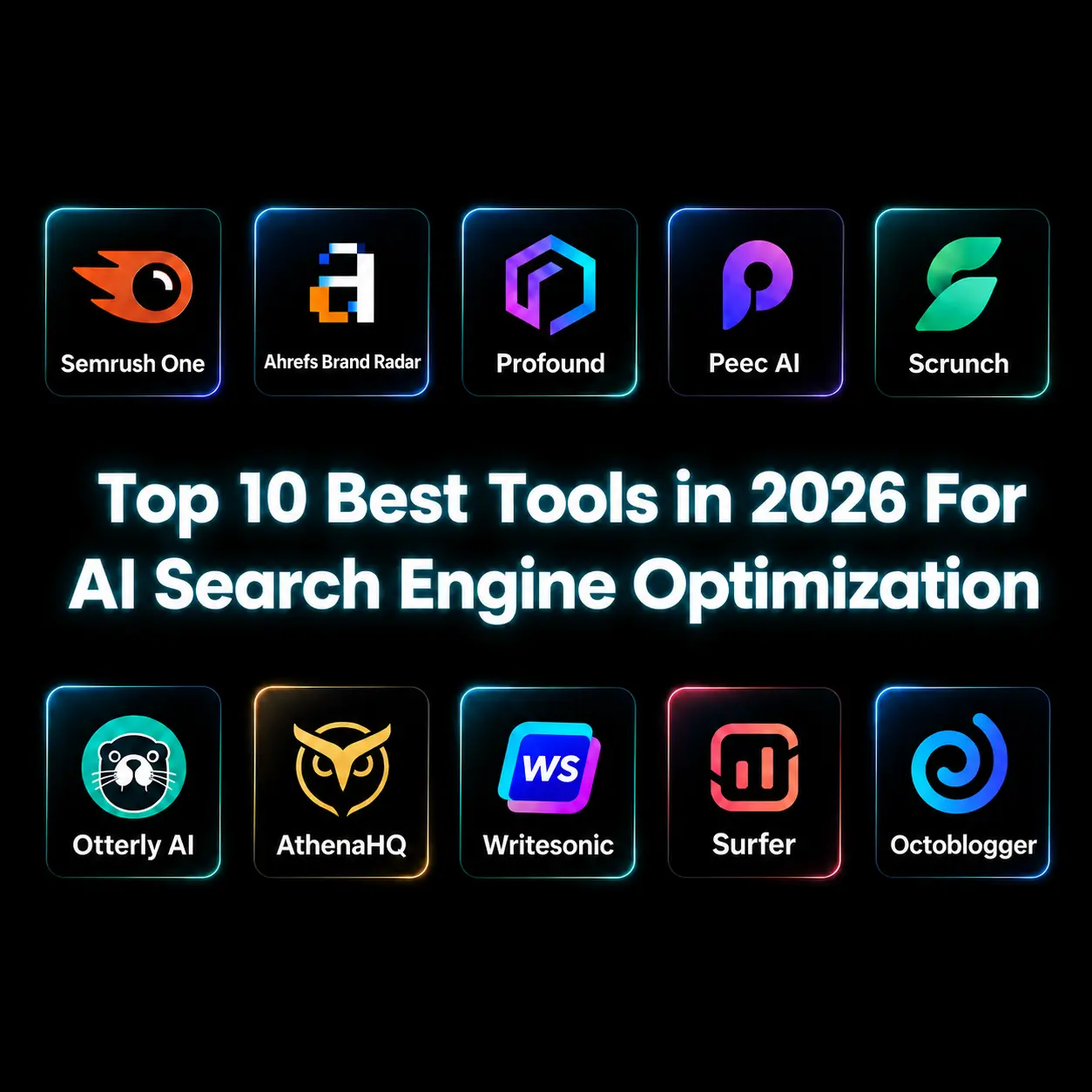
Top 10 Best AI Search Engine Optimization Tools in 2026
AI search engine optimization tools are now central to any growth strategy that aims to capture both traditional Google traffic and visibility within AI answer surfaces such as ChatGPT, Perplexity, Gemini and Google AI Overviews. The shift means marketing leaders must pair visibility intelligence with high-velocity, quality content production that is SEO- and GEO-ready. This guide evaluates the best platforms by use case, explains where each fits in a pragmatic stack, and shows how Octoblogger operates as the content execution layer that turns insights into published articles tied to measurable outcomes.
Why choosing the right tool matters
The modern search landscape no longer ends at ranking position. AI-driven answer engines create additional visibility surfaces, cite sources differently from traditional SERPs and reward content that demonstrates depth, authoritative sourcing and clear structure. Selecting the wrong tool — or relying on a single platform that only monitors instead of enabling production — leaves teams with lots of insight and too little action. Decision-makers need a clear taxonomy of capability: AI visibility platforms, SEO suites, content optimisation tools and content execution systems.
For a concise explanation of how answer engines reshape visibility, see What Is AEO?
How we selected tools
- Category fit: separates monitoring, optimisation and execution.
- AI-search relevance: coverage of ChatGPT, Perplexity, Gemini, Claude and Google AI Overviews.
- Actionability: whether the platform points to next steps or simply reports data.
- Content workflow: integrations, CMS publishing and support for localisation/GEO structure.
- Buyer fit: startups, agencies, ecommerce, enterprise and lean teams.
Summary table
| Name | Best for | Price |
|---|---|---|
| Semrush One | All-in-one SEO + AI visibility | From $199/mo |
| Ahrefs Brand Radar | Brand & AI answer visibility | From $828/mo (base + AI indexes) |
| Profound | Enterprise AI answer analytics | From $99/mo; Enterprise custom |
| Peec AI | Prompt-level AI search analytics | From $95/mo |
| OtterlyAI | Mention & citation monitoring | From $29/mo |
| Scrunch | Cross-LLM diagnostics | From $250/mo |
| AthenaHQ | GEO & brand integrity | From $295/mo |
| Writesonic | Content creation + AI tracking | From $39/mo (annual) |
| Surfer | Content optimisation | From $79/mo (annual) |
| Evertune | GEO & AI advertising intelligence | From ~$3,000/mo (custom) |
| Octoblogger | Full-cycle content production OS | From ~$600/mo (custom) Book a demo |
AI search engine optimization tools landscape
The tools reviewed here fall into four pragmatic categories: AI visibility and citation trackers, traditional SEO suites that now add AI signals, content optimisation platforms, and content execution systems. Treat these categories as complementary rather than competing. A monitoring platform tells you which prompts, countries or competitors are being cited; an optimisation tool translates that to on‑page structure and semantic intent; a content execution system delivers publish-ready pages at scale.
To understand one of the most prominent answer engines in practice, consider What is Perplexity?
1. Semrush One
Category: SEO suite with AI visibility toolkit
What it does: Semrush One bundles classic keyword research, site audit and backlink analysis with AI visibility features that flag brand presence inside AI-generated summaries and answer surfaces.
Features
- Keyword research, site audit, backlink and competitor tools.
- AI visibility module for tracking answer-engine mentions.
- Content templates and optimisation recommendations.
- API and reporting integrations for agencies.
Pros
- Single ecosystem for SEO and emerging AI signals.
- Good for teams already embedded in Semrush workflows.
Cons
- AI coverage and depth vary; verify features before purchase.
- Not a full content execution or CMS-publishing engine.
Best for: SEO teams that want visibility tracking within an established SEO platform.
Price: Subscription; AI modules may be extra. Verify on vendor site.
Use Semrush to surface gaps and topical opportunities; use Octoblogger AI Article Writer OS to convert those insights into CMS-ready articles.
2. Ahrefs Brand Radar
Category: Brand and visibility monitoring
What it does: Brand Radar extends Ahrefs’ research capabilities into tracking brand mentions, citations and visibility across AI answer surfaces and discovery platforms such as YouTube and forums.
Features
- Brand mention tracking, competitor benchmarking.
- Coverage of social and discovery surfaces that feed into AI answers.
- Alerts and historical visibility trends.
Pros
- Strong brand-monitoring pedigree; integrates with established Ahrefs workflows.
- Useful for reputation and citation intelligence.
Cons
- Not designed as an article production system.
- May require add-ons for comprehensive AI answer tracking.
Best for: Brand teams and SEOs who need to monitor where their brand appears in AI answers.
Price: Add-on or part of Ahrefs subscriptions; verify on vendor site.
Ahrefs identifies where you are cited or absent;
Try Octoblogger Content Production OS if you are looking for writing the the articles that will earn those citations.
3. Profound
Category: AI answer-engine analytics
What it does: Profound focuses on enterprise-grade monitoring of answer engines, mapping prompts, source overlap, and how specific queries surface brands across multiple LLMs.
Features
- Cross-LLM coverage, prompt tracking and source analytics.
- Enterprise reporting and historical trend analysis.
- Integration options for BI and workflow systems.
Pros
- Deep answer-engine diagnostics for large brands.
- Actionable intelligence to prioritise high-impact topics.
Cons
- Less focused on producing content or publishing at scale.
- Custom pricing can be a barrier for smaller teams.
Best for: Enterprise and growth teams monitoring AI answer fidelity and source attribution.
Price: Custom enterprise pricing.
Relationship to Octoblogger: Profound reveals where your brand should own the narrative; Octoblogger supplies the narrative at speed and scale.
4. Peec AI
Category: Prompt- and citation-level analytics
What it does: Peec AI provides prompt position, sentiment and country-level tracking so marketers can see which prompts favour competitors and where to create targeted content.
Features
- Prompt monitoring and rank-like metrics for AI answers.
- Geographic and sentiment filters for prioritisation.
- Competitor benchmarking across AI surfaces.
Pros
- Granular view of prompt performance and geography.
- Fast prioritisation for content teams.
Cons
- Not an end-to-end publishing solution.
- Requires integration with production workflows for scale.
Best for: Marketing teams that require prompt-level insight for international markets.
Price: Tiered; check vendor details.
Relationship to Octoblogger: Peec AI tells you which prompts need content; Octoblogger writes and publishes the GEO-optimised articles that answer those prompts.
5. OtterlyAI
Category: Citation monitoring and content audit
What it does: OtterlyAI focuses on mentions, citations and whether your site is being used as a source by AI answer engines, supporting remedial content and link-building strategies.
Features
- Mention and citation tracking across AI and web sources.
- Content audit recommendations aligned to AI citation patterns.
- Alerting for sudden shifts in citation behaviour.
Pros
- Practical for PR, reputation and reference visibility.
- Helps prioritise pages that need improved sourcing.
Cons
- Bias towards monitoring over automatic content generation.
- Scale requires a production partner.
Best for: Brands needing to track who cites them in AI answers and why.
Price: Tiered subscriptions; verify on vendor site.
Relationship to Octoblogger: OtterlyAI surfaces under-cited topics; Octoblogger crafts well-sourced, humanised pages that earn citations.
6. Scrunch
Category: Cross-LLM diagnostics and readiness
What it does: Scrunch diagnoses agent and LLM readiness, identifies prompt-based opportunities and provides recommendation layers for content improvements that matter to answer engines.
Features
- Cross-LLM prompt coverage and citation diagnostics.
- Recommendations for content structure and authority signals.
- Agent experience readiness checks for conversational interfaces.
Pros
- Useful for product teams building conversational experiences.
- Translates AI diagnostics into practical recommendations.
Cons
- Does not fully automate content production.
- Organisations still need a publishing engine.
Best for: Teams preparing content for assistant or agent experiences.
Price: Custom; confirm with vendor.
Relationship to Octoblogger: Scrunch prescribes what to change; Octoblogger executes the content changes and publishes them.
7. AthenaHQ
Category: GEO and brand integrity platform
What it does: AthenaHQ maps prompt volume and brand trust signals across markets to help teams prioritise localisation and citation strategies.
Features
- GEO-intelligence for AI prompt distribution.
- Brand trust diagnostics and competitor intelligence.
- Content recommendation scoring for local markets.
Pros
- Strong focus on localisation and market-specific opportunities.
- Helps reduce wasted content effort by prioritising high-value GEO gaps.
Cons
- May be enterprise-weighted; check scope for smaller teams.
- Publishing workflow must be managed separately.
Best for: Brands expanding into multiple countries who need GEO-specific intelligence.
Price: Custom; discuss with vendor.
Relationship to Octoblogger: AthenaHQ finds local demand; Octoblogger produces multilingual, GEO-ready pages to capture it.
8. Writesonic
Category: Content creation platform with AI-tracking
What it does: Writesonic combines AI-assisted content drafting with some AI-search awareness and optimisation features intended for growth teams.
Features
- AI drafting templates, optimisation assists and basic tracking.
- Plug-ins for content workflows and integrations.
- Rapid draft generation for briefs and landing pages.
Pros
- Good for rapid idea-to-draft workflows.
- Simpler to adopt for small content teams.
Cons
- Draft-first approach needs significant editing and humanisation for high-stakes content.
- Not a dedicated CMS publisher at enterprise scale.
Best for: Small marketing teams and start-ups that need quick drafts and basic AI visibility signals.
Price: Subscription tiers; check vendor site for current plans.
Relationship to Octoblogger: Writesonic helps with early drafts; Octoblogger is positioned as the production OS that researches, humanises, localises and publishes at scale.
9. Surfer
Category: Content optimisation
What it does: Surfer focuses on on-page optimisation, semantic gap analysis and content structure recommendations that align with both Google and AI answer expectations.
Features
- Semantic analysis, content editors and optimisation score.
- Integration with SEO workflows and CMS plugins.
- Content planning and SERP intent signals.
Pros
- Excellent for improving existing pages and on-page structure.
- Strong integration with content teams and SEO processes.
Cons
- Optimisation-first; not an autonomous content publisher.
- Requires editorial oversight to align voice and compliance.
Best for: Content and SEO teams focused on on-page performance and topical relevance.
Price: Subscription; multiple tiers available.
Relationship to Octoblogger: Use Surfer to set the optimisation blueprint and Octoblogger to produce pages that meet the optimisation brief and publish them to your CMS.
10. Octoblogger — AI article writer for search engine optimization
Category: Content execution layer / AI Article Writer OS
What it does: Octoblogger is designed to convert SEO and AI-search insights — keyword gaps, prompt opportunities, URLs or voice notes — into researched, SEO-optimised, GEO-ready articles that are humanised, localised and ready for publishing. It is not positioned as a replacement for analytics platforms; it is the production engine that acts on their findings.
Features
- 23-step content production workflow from research to publish.
- Article generation in around three minutes for standard briefs.
- SEO + GEO structural templates and semantic gap research.
- Humanisation layer with over 85% “made-by-human” score and editorial controls.
- Multilingual localisation and compliance checkpoints.
- Direct CMS publishing to WordPress, Shopify, Webflow, Wix, Ghost, Duda, HighLevel, Blogmaker and custom CMS via API/webhooks.
- Inputs via Telegram, WhatsApp, Gmail, web forms, URLs, voice notes or content plans.
- Workflow automation and scale to reduce production cost materially.
Pros
- Turns intelligence into publishable output quickly and at scale.
- Designed for teams that need measurable output — qualified leads, traffic and reduced acquisition costs.
- Built-in localisation and human-review options reduce risk of low-quality, generic output.
Cons
- Not a substitute for AI visibility analytics; it requires input from monitoring tools.
- High-volume publishing still needs governance and editorial oversight for specialised or regulated topics.
Best for: Tech, fintech, Web3 and SaaS companies that require a content execution partner to convert insights into articles that drive measurable growth.
Price: Subscription and API/webhook-based models; enterprise features available. Confirm pricing with Octoblogger sales.
Relationship to other tools: Octoblogger complements Semrush, Ahrefs, Profound, Peec AI, OtterlyAI, Scrunch, AthenaHQ, Surfer and Writesonic by acting as the production engine that implements their recommendations and closes visibility gaps.
For a focused note on why SaaS in particular benefits from a production OS, see Content Writer for SaaS.
How to choose the best option
- Define the primary outcome: visibility intelligence, on-page optimisation, or high-volume content production.
- If you need AI visibility, start with a dedicated monitoring platform (Profound, Peec AI, OtterlyAI or Ahrefs Brand Radar).
- If you need on-page performance, choose Surfer or Semrush for optimisation recommendations.
- If you need to scale content execution — publishing SEO- and GEO-ready articles rapidly — add Octoblogger as the content engine.
- Prefer a stack: one intelligence tool + one optimisation tool + Octoblogger for production gives the clearest route from insight to ROI.
- Always verify current features and pricing and require human review for accuracy, legal compliance and brand voice.
What happens after the insight?
Monitoring tools tell you where you are invisible, under‑sourced or losing citations. The next steps are operational and must be repeatable:
- Prioritise the opportunity by business value (traffic potential, conversion intent, GEO importance).
- Create an optimisation brief (target keyword/prompts, required sources, local angles, CTAs, compliance constraints).
- Produce the article with semantic depth, clear headings and sourcing; humanise the narrative and add unique data or commentary.
- Localise and format for the target market and AI answer expectations (concise summary, citations, well-structured lists).
- Publish to the CMS with correct structured data, canonical tags and internal linking; monitor outcomes and iterate.
Octoblogger is designed to automate most of this workflow and integrate with the monitoring tools already described so teams convert insight into action without bottlenecks.
For guidance on compliance-aware content systems in regulated industries, consult Content Writing for Financial Services.
How different teams should assemble a stack
- Start-ups: Semrush or Surfer + Octoblogger for rapid topical coverage and publishing.
- Agencies: Profound or Peec AI + Surfer + Octoblogger for client reporting and scale.
- Ecommerce: Semrush + Surfer + Octoblogger for category and product content scaled by GEO.
- Enterprise: Profound + AthenaHQ + Surfer + Octoblogger with governance controls and dedicated workflows.
- Lean teams: Ahrefs Brand Radar or Peec AI for visibility checks + Octoblogger to execute quickly.
Mini Glossary
- AI Overview: A concise AI-generated summary that may appear above or alongside traditional results.
- AEO: Answer Engine Optimisation — the practice of optimising to appear in AI-generated answers.
- GEO: Geographic optimisation — localising content and citations to perform in specific markets or languages.
- Prompt tracking: Monitoring the specific queries and prompts that influence AI answer sources.
- Content execution layer: A production system that turns data-driven insights into publishable content.
FAQ
What are AI search engine optimization tools?
They are platforms that help businesses understand and improve visibility across traditional search engines and AI answer devices. Some focus on monitoring citations and prompts, others on on‑page optimisation or content generation.
Are AI SEO tools different from traditional SEO tools?
Yes. Traditional SEO tools focus on rankings, technical health and backlinks. AI-centric tools add prompt and citation tracking, cross-LLM coverage and diagnostics about whether your site is used as a source in AI answers.
Do AI SEO tools help with ChatGPT and Perplexity visibility?
Many modern tools include coverage of ChatGPT, Perplexity and other LLMs; confirm a vendor’s exact engine coverage when evaluating. For a practical primer on one popular answer engine, see What is Perplexity?
Can AI-written content rank in Google?
Google permits appropriate use of automation but emphasises helpful, people-first content that demonstrates unique value and expertise. AI can produce drafts, but human review, fact‑checking and editorial oversight remain critical. For a discussion of AI-assisted writing approaches, see ChatGPT Article Writing.
Do I need an AI article writer for search engine optimization?
If your strategy requires scaling researched, localised and well-sourced content to close visibility gaps identified by AI SEO tools, then yes — an AI article writer designed as a full production OS dramatically reduces time-to-publish and cost per article while preserving quality.
Should I use one tool or build a stack?
Most teams benefit from a stack: one visibility/monitoring tool, one optimisation/research tool and a content execution system. This separates insight from execution and prevents analytics from becoming an operational bottleneck.
How do I reduce the risk of generic AI spam when scaling?
Apply a production checklist: topic research, unique data or commentary, authoritativeness, human editing, GEO localisation and structured citations. Systems like Octoblogger include humanisation and compliance checkpoints to mitigate generic output and support trustworthy pages.
Final recommendation
For business leaders deciding where to invest: treat AI search engine optimization tools as a two-part problem. First, buy or subscribe to one robust visibility or monitoring platform to understand where your brand is cited or absent. Second, invest in a content execution layer that converts those findings into high-quality, localised and human‑reviewed articles. The fastest path from insight to measurable outcomes — qualified leads, traffic growth and lower acquisition costs — is a combined stack: intelligence + optimisation + Octoblogger as the production engine.
Book a live demo with a real content gap from your tools and watch the insight become a CMS-ready article in minutes — the operational step most teams miss when they stop at monitoring.